Table of Contents
Introduction
Situated in the south-east of Amsterdam, the district known as Bijlmermeer (often simply “Bijlmer”) stands as one of the most ambitious and revealing urban experiments of post-war Europe.
It was conceived as a model for the high-rise suburban ideal: light-filled apartments, open green spaces, and a modern way of life.
Today, in 2026, Bijlmer’s story continues to be transformed, contested, and rich with lessons for cities worldwide.
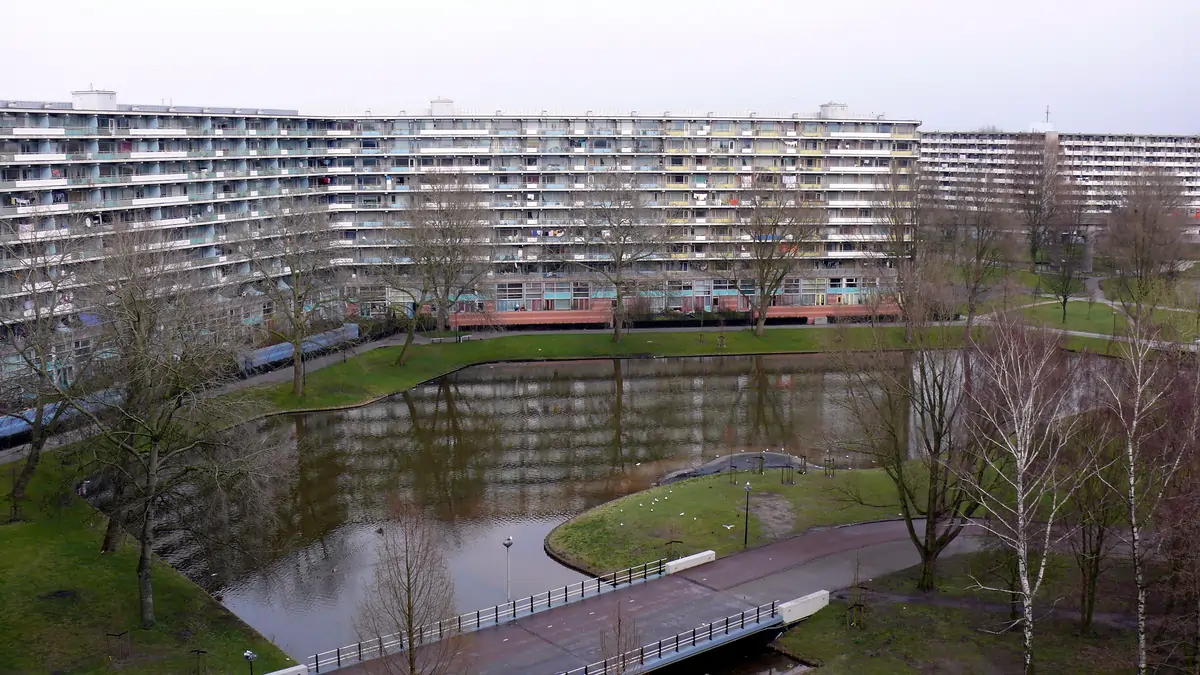
1. Origins: A Modernist Utopia (1960s-70s)
The masterplan for the Bijlmermeer emerged in the mid-1960s, led by Dutch architect Siegfried Nassuth and his team.
Drawing directly on the high modernist principles of the Congrès Internationaux d’Architecture Moderne (CIAM) and Le Corbusier.
Key features included:
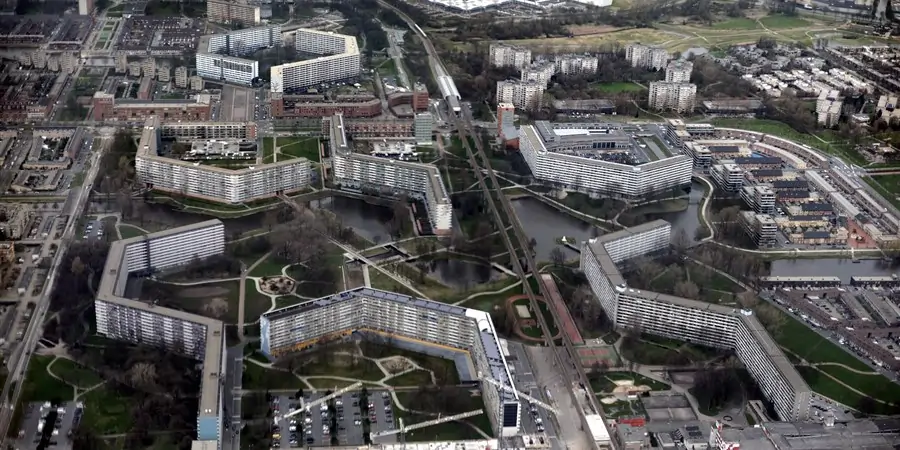
- A hexagonal “honeycomb” layout of high-rise towers to maximise sunlight and open ground space.
- Separation of traffic, living, and recreation in strict zoning.
- Apartments are intended for middle-class families, but with economies of scale in concrete construction.
However, the plan also had intrinsic vulnerabilities: delays in transport connections, monotony of towers, and competition from nearby low-rise housing developments.
2. Rapid Decline & Social Challenges (1970s-1990s)
By the 1970s, the Bijlmer’s promise had begun to falter. The metro line was delayed, access roadways were inadequate, and the housing market shifted.
Empty apartments began to attract lower-income tenants and immigrant communities, altering the demographic and social mix.
The architecture itself, with extensive corridors, large elevated open spaces, and identical balconies, came to be criticised as alienating and unsafe.
3. Turning Point: The 1992 Plane Crash & Urban Renewal (1992-2000s)
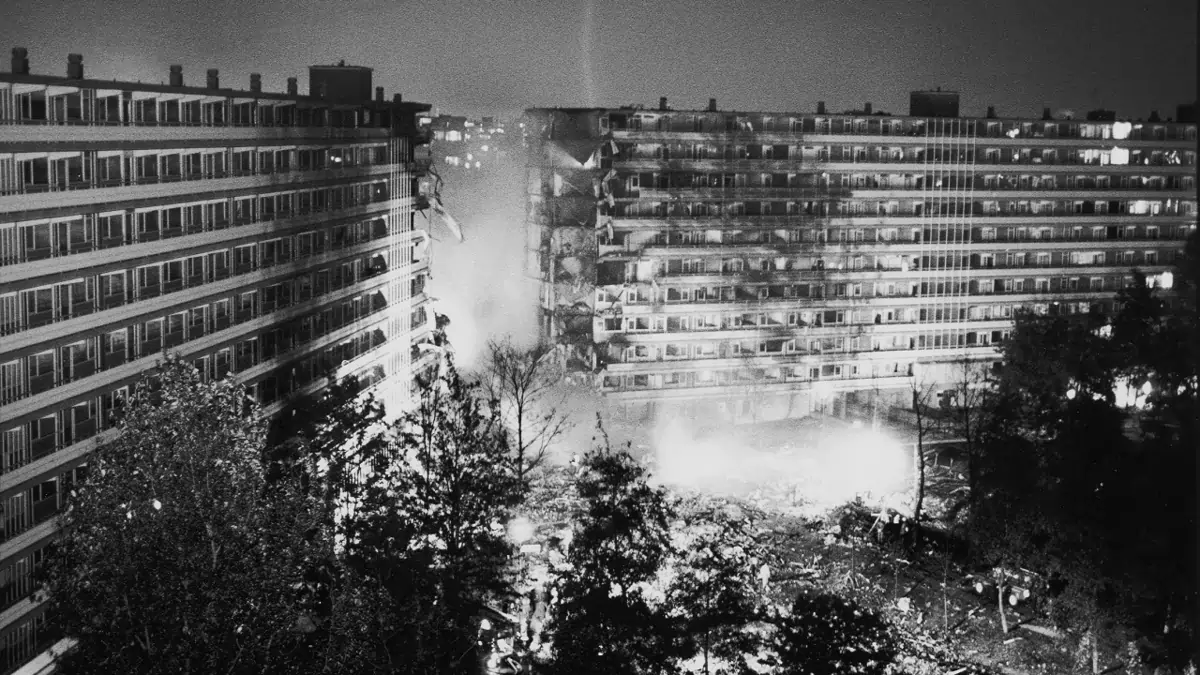
On 4 October 1992, a cargo flight operated by El Al (Flight 1862) crashed into two of the high-rise blocks at Bijlmer, killing 47 people and destroying apartments.
This catastrophe didn’t cause the renewal alone, but it galvanised public attention and triggered major restructuring.
Urban renewal followed: large towers were demolished, the elevated traffic system was dismantled, and ground-level streets and green spaces were introduced.
New housing models emphasised mixed tenure, low-rise developments, and ownership rather than purely rental.
4. The Built Environment Transformed (2000-2026)
Between 2000 and 2026, the built fabric of Bijlmer changed substantially:
- Several of the original high-rise blocks were torn down and replaced by low-rise, terraced housing and mixed-use buildings.
- Some remaining towers were renovated with improved facade, access control and community facilities.
- Elevated roads were removed or repurposed; new street-level retail and public spaces were introduced.
- The zone around the Johan Cruijff ArenA and the Arena Boulevard was expanded into a major entertainment and commercial hub.
Today, you can still find examples of the original “honeycomb” blocks (e.g., the protected G/K neighbourhood) that serve as architectural heritage, though their context and uses have shifted.
5. Demographics & Economy Today (2020-26)
- Population: The district is home to a highly diverse population with over 150 nationalities represented; a significant portion is first-generation or second-generation migrants.
- Housing tenure: Ownership rates have increased; low-rise houses and buy-to-own schemes complement social rental housing.
- Employment & income: Unemployment rates have declined since the 1990s, but still remain higher than the Amsterdam average. Several community-economy projects and creative business hubs aim to boost local employment.
- Crime & safety: Reported crime has decreased significantly since the 1990s; however, perceptions of safety vary between neighbourhoods, especially in older high-rise zones.
- Urban branding: The municipality of Amsterdam now promotes Bijlmer as a “living lab” of multicultural urbanism and creative economy, balancing regeneration with authenticity.
6. Culture & Identity
Today’s Bijlmer is far more than its urban planning story. It has emerged as one of Amsterdam’s most distinctive multicultural districts:
- Street life & food: Surinamese, Ghanaian, Antillean, Turkish and Dutch-migrant cuisines side by side in cafés and street markets.
- Arts & music: The district hosts festivals (e.g., Kwaku Festival), murals, creative studios and a growing music scene with roots in diaspora culture.
- Community initiatives: Local organisations focus on youth engagement, entrepreneurship and intercultural dialogue, shifting the public-space narrative from deficit to asset.
7. Transport & Infrastructure Connectivity
Connectivity has become a major asset of Bijlmer:
- Metro & rail: Two metro lines service the area, along with four major railway stations linking to Amsterdam centre and the national rail network.
- Road & motorways: The A1, A2, A9 and A10 motorways border the district, giving good regional access.
- ArenA precinct: Around Johan Cruijff ArenA lies a large retail/leisure zone (ArenA Boulevard, Amsterdamse Poort) that draws visitors and supports local commerce.
8. Living or Visiting Bijlmer – What to Know
Whether you’re considering living, visiting or investing in Bijlmer:
- Neighbourhoods: Low-rise zones such as Haveneiland and Karspeldreef tend to be quieter and higher tenure; the eastern “G/K” high-rise zone is more budget-rental and is currently undergoing reform.
- Housing market: While prices have risen, the market remains relatively affordable compared to central Amsterdam, but be aware: some properties are targeted at owner-occupiers and may exclude minimum-income households.
- Safety & perception: Many parts of Bijlmer are safe and lively; event nights (stadium, concerts) activate zones; yet, older high-rise blocks may still carry stigma or lower service levels.
- What to do: Visit the ArenA precinct, the local markets, the Nelson Mandela Park, creative hubs like the Bijlmerplein, and explore food scenes off the beaten path.
- Transport tip: Use the metro or rail for direct access; for car trips, note the busy motorways at peak hour.
9. Global Lessons & Future Outlook
Bijlmer’s journey offers lessons for large-scale housing estates globally:
- The dangers of high-rise monotony + delayed infrastructure.
- The necessity of mixed tenure, mixed use, and community engagement.
- The importance of adaptable urban fabric and social programmes.
Looking ahead, Bijlmer is shaping into a “city-in-a-city” of multicultural innovation, creative economy and sustainable living.
Planned future developments include (2025-30): green retrofit of remaining towers, expansion of co-living hubs, and stronger local entrepreneurship ecosystems.
FAQs
Q: Is Bijlmer still a high-crime area?
A: No, while some perceptions persist, crime rates have fallen, and many neighbourhoods are now much safer than two decades ago.
Q: Can foreigners buy property in Bijlmer?
A: Yes, like elsewhere in the Netherlands, non-residents can purchase property, but mortgage eligibility and income rules still apply.
Q: What transport links serve Bijlmer?
A: Two metro lines, four railway stations, multiple bus routes and motorway access via A1/A2/A9/A10.
Q: Which neighbourhoods are best for families?
A: Low-rise sectors like Haveneiland and adjacent zones offer green space, owner-occupied houses, and better connectivity for families.
Conclusion
From its bold genesis as a modernist experiment to its current identity as a multicultural and evolving district, Bijlmermeer tells a compelling story of urban ambition, challenge and renewal.
For visitors, residents and urban scholars alike, it stands as one of Amsterdam’s most dynamic and instructive neighbourhoods.
Whether you come for architecture, culture or community, Bijlmer invites you to look beyond the headlines and experience its many layers.
Amsterdam’s Ongoing Urban Evolution: From Bijlmermeer to Entrepotbrug
Just as the Bijlmermeer represents Amsterdam’s post-war vision for modern suburban living, Entrepotbrug on the city’s eastern edge tells a parallel story of transformation, one rooted in adaptive reuse and architectural reinvention.
Where Bijlmer rose from concrete utopian ideals, Entrepotbrug evolved from 19th-century warehouses and canals into a vibrant residential and cultural zone.
Both areas reveal how Amsterdam continuously reshapes its urban fabric: preserving history, embracing innovation, and creating liveable, connected neighbourhoods that reflect the city’s evolving social heartbeat.