Table of Contents
Introduction: The Invisible Institution That Still Shapes the World
In Amsterdam, there is no grand building, museum wing or brass plaque commemorating the Amsterdam Exchange Bank (Amsterdamsche Wisselbank).
Yet this institution, founded in 1609, placed into liquidation in 1819, and formally dissolved by 1820, laid the foundations for modern financial stability.
Its innovations still live inside every central bank, every digital ledger and every international settlement system.
This is the story of how Amsterdam transformed money from chaos into a global mechanism of trust.
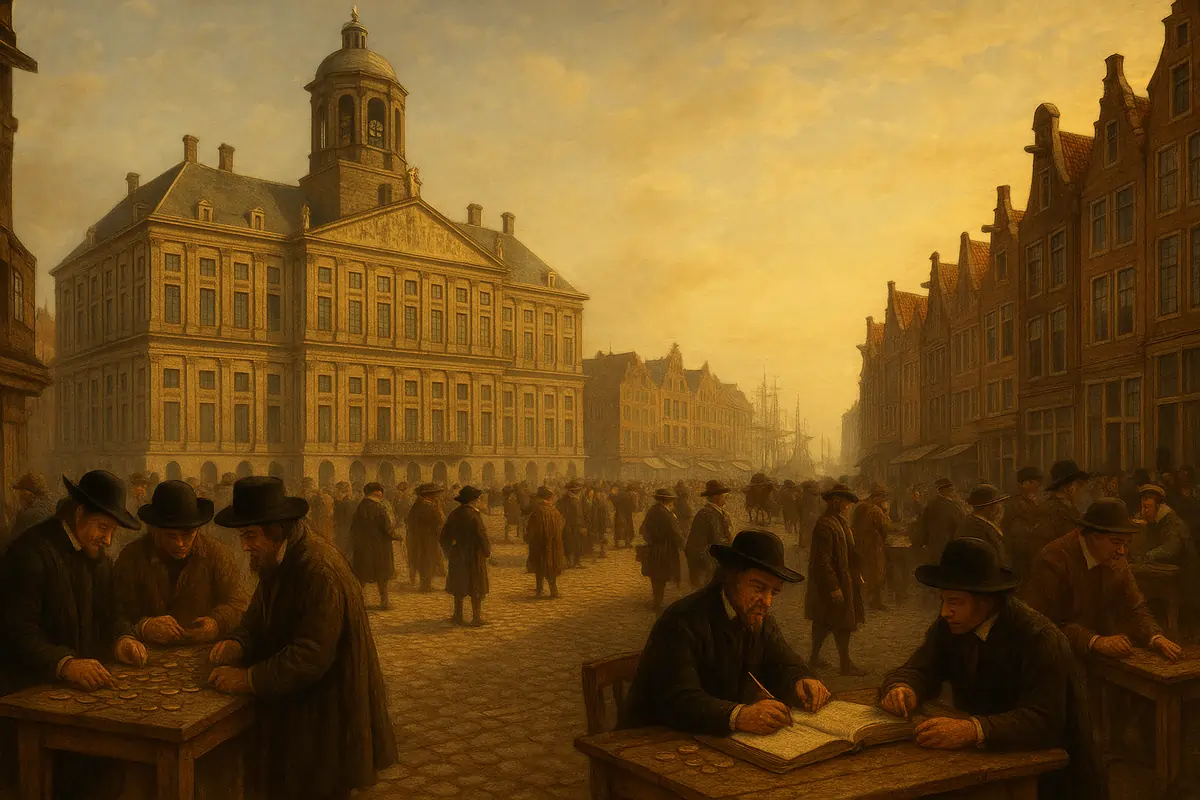
Before the Bank: A City in Monetary Chaos
By the early 17th century, Amsterdam had become Europe’s rising commercial superpower. But prosperity arrived with a crippling structural problem: money stopped functioning efficiently.
After the fall of Antwerp (1585), the financial centre of Europe shifted north. Trade exploded, ships multiplied, and merchants from across the world arrived with their own coins.
The result?
Around 500 different coins circulated in Amsterdam, each with varying weights, silver content and reliability.
Merchants faced:
- Debased or clipped coins
- Counterfeits in circulation
- Exchange rates fluctuate multiple times a day
- Slow, risky international transfers
- Disputes over coin quality and real value
For a global trading hub, this was unsustainable. Amsterdam needed a monetary anchor.
1609: The Radical Dutch Solution
Inspired by municipal banks in Venice and Genoa, Amsterdam designed a more ambitious model: a publicly guaranteed, non-lending exchange bank.
Its core innovations transformed world finance:
1. “Bank Money” Backed by Real Metal
Depositors exchanged their mixed-quality coins for a stable, ledger-based currency.
No clipping, no debasement, just verified metal value.
2. A Neutral, Public Ledger
Large payments are now moved as entries in a book, not as sacks of coins.
This reduced risk and sped up international trade.
3. A Trusted Standard for Global Commerce
Bank money became the preferred medium for high-value transactions across Europe.
4. Strict Prohibition on Lending
To protect trust, the bank was barred from issuing loans. Deposits were to remain fully backed at all times.
With these principles, Amsterdam didn’t just solve local monetary chaos; it set a new global benchmark.
Amsterdam’s Golden Age: When Trust Became an Export
Between 1620 and 1720, the Exchange Bank became the financial backbone of the Dutch Golden Age.
Its impact:
• Europe’s most trusted currency
Bank money was so stable that it became a de facto international reserve currency.
• A global payments network
Merchants from the Mediterranean to the Baltic settled bills through Amsterdam fast and reliably.
• A stabiliser in times of crisis
During political upheavals, wars, or speculative frenzies, the Wisselbank maintained convertibility. This earned it a reputation for unshakable reliability.
The true genius of the bank wasn’t technology; it was trust.
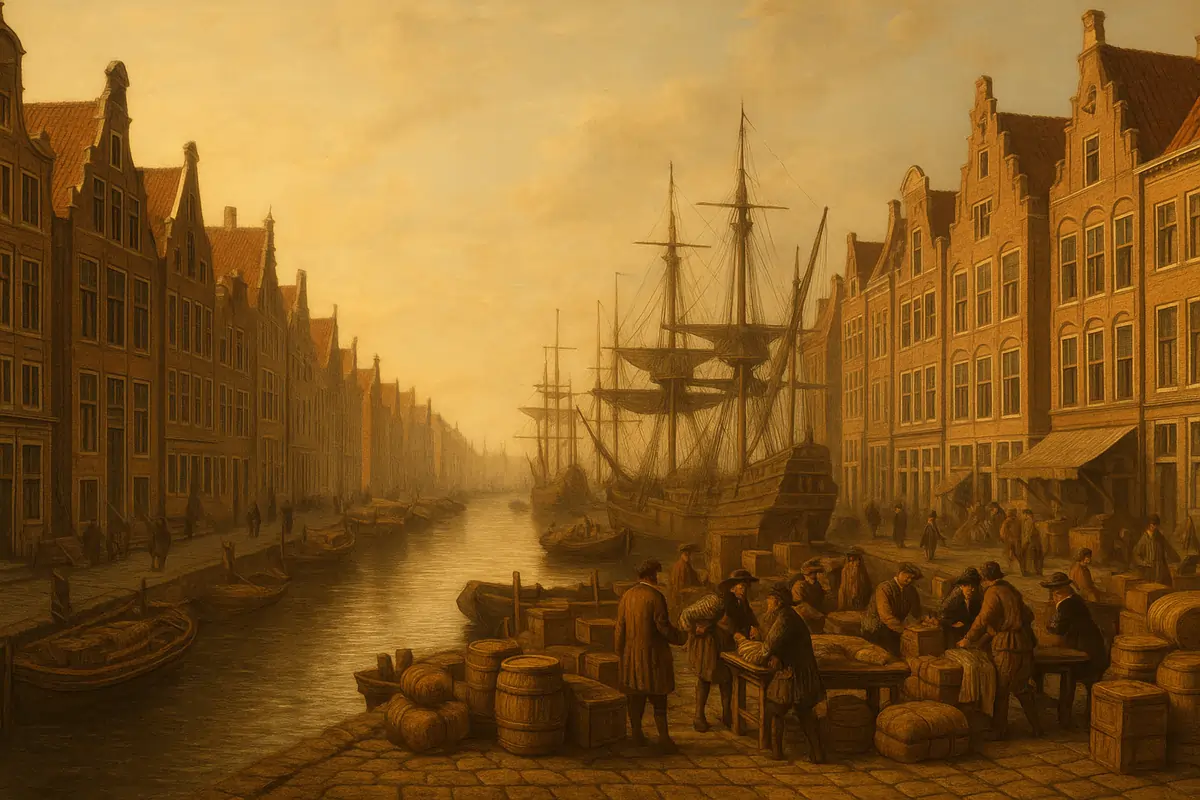
The Quiet Decline: When Rules Were Broken
Over time, however, the bank drifted away from its founding principles.
How the downfall began:
- The VOC (Dutch East India Company), once spectacularly profitable, began to weaken.
- To keep it afloat, the Exchange Bank quietly extended loans in violation of its charter.
- These loans grew, became riskier and were concealed from the public.
- Meanwhile, financial centres like London modernised rapidly, eroding Amsterdam’s advantage.
By undermining transparency, the bank eroded the very mechanism that made it successful.
1819–1820: Liquidation and Dissolution
- In 1819, the bank was formally placed into liquidation as its condition could no longer be defended.
- 1820 liquidation was completed, and the institution was dissolved. Its functions were absorbed into the newly established Dutch National Bank (1814).
The rise and fall of the Wisselbank foreshadows every modern financial crisis: innovation without oversight eventually collapses.
What Remains Today? A Legacy Without a Monument
Despite its historical importance, very little of the Wisselbank survives physically:
- It operated inside the old Amsterdam Town Hall, today the Royal Palace on Dam Square.
- No original banking rooms remain.
- A few artifacts (ledger books, coins, a money wagon) survive in museum collections.
Its absence is striking: one of the most influential banks in history has no visible memorial in the city it transformed.

Why the Amsterdam Exchange Bank Still Matters
The Wisselbank’s conceptual legacy is monumental:
• Blueprint for Central Banks
Its principles, stable currency, guaranteed deposits, and transparent accounting, echo in modern central banks worldwide.
• Foundation of Modern Settlement Systems
Its ledger system resembles today’s digital clearing networks.
• Precursor to Stable Value Currencies
“Bank money” anticipated the logic behind currency boards, stablecoins and electronic reserves.
• Timeless Regulatory Lessons
Concealed lending and lack of oversight demonstrate that trust can be destroyed from within, a warning still relevant today.
Amsterdam’s real export wasn’t goods, it was confidence.
Evergreen Lessons From a Bank That Changed the World
The Wisselbank’s story teaches durable, universal lessons:
1. Trust is the ultimate infrastructure.
Without reliable money, no maritime or digital empire can survive.
2. Transparency matters more than innovation.
The greatest banking idea collapsed because its rules were ignored.
3. Global finance grows where trust is centralised.
Amsterdam’s clarity attracted the world’s merchants; its decline scattered them elsewhere.
4. Institutions fade, ideas endure.
The bank disappeared, but its concepts shaped the Bank of England, the Dutch National Bank, and eventually the Eurosystem.
Conclusion: The Quiet Architect of the Modern Financial World
The Amsterdam Exchange Bank left no monument, no towering vaults and no preserved trading floor.
Yet its innovations underlie the financial systems used in every nation today. It solved a crisis of fragmented money, powered the Dutch Golden Age, and pioneered ideas centuries ahead of their time.
Placed into liquidation in 1819 and dissolved in 1820, the Wisselbank is gone. Still, its architecture lives on in every central bank ledger, every digital transfer and every moment global commerce depends on trust.
The Amsterdam Exchange Bank may be invisible, but it remains one of the most influential institutions ever created.
Amsterdam’s Private Banking Power: The Rise of Hope & Co.
While the Amsterdam Exchange Bank laid the foundation for public financial stability, the city’s rise as a global financial capital was equally shaped by private banking dynasties.
One of the most influential was Hope & Co., often referred to as the Hope Bank.
To explore how Amsterdam’s banking power shifted from public institutions to private families and how Hope & Co. became one of the most powerful financial houses of the 18th century, read the full story.