In 1917, Amsterdam made one of the most influential planning decisions in its history.
It approved Plan Zuid (Plan South), a bold urban expansion designed by master architect Hendrik Petrus Berlage.
The plan transformed empty meadows between the Amstel and the Schinkel into a model of dignified social housing, harmonious city planning, and expressive architecture.
More than a century later, the district still stands as one of Europe’s most successful examples of early 20th-century urban design.
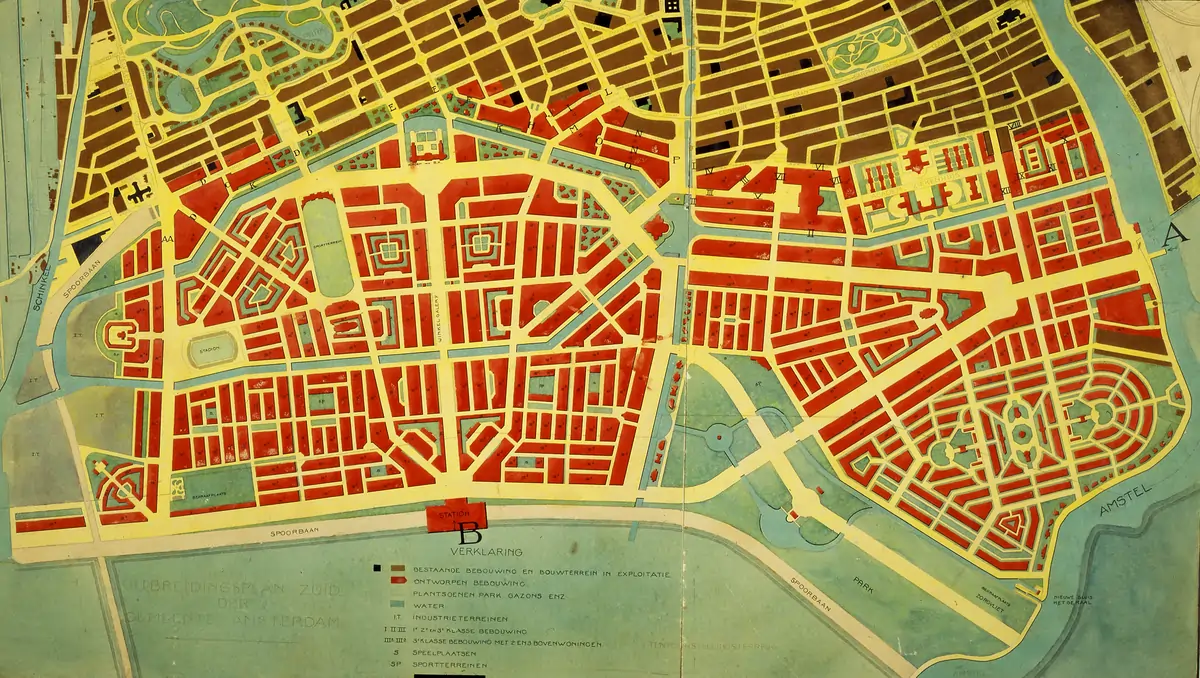
Table of Contents
The Housing Reform That Set the Stage (1901–1915)
At the start of the 20th century, Amsterdam was facing a crisis. Rapid population growth had pushed working-class families into crowded, unhealthy housing.
In response, the Dutch government introduced the Housing Act of 1901, giving municipalities new powers and responsibilities to build modern, regulated dwellings.
The city identified a vast, undeveloped area south of the existing urban core, stretching from the Amstel River to the Schinkel, as ideal for expansion.
To design this new district, Amsterdam turned to H.P. Berlage, already renowned for the Beurs van Berlage and his rational, human-centred design philosophy.
- 1914: Berlage began drafting early versions of the plan.
- 1915: He presented the definitive proposal, which would become Plan Zuid.
- 1917: The city formally approved the plan after wartime delays.
This timeline aligns with the strongest historical evidence available in Dutch architectural and municipal sources.
A New Vision for Healthy, Harmonious Urban Life
Berlage’s Plan Zuid proposed something revolutionary: A modern district where beauty, greenery, affordability, and dignity coexisted.
Key Elements of Berlage’s Urban Vision
• Paris-inspired boulevards and rhythmic side streets
Grand avenues formed the district’s spine, supported by quieter residential grids.
• Green interior courtyards
Each housing block surrounded a spacious, light-filled courtyard, an antidote to the cramped alleys of 19th-century Amsterdam.
• Squares, water, and public space as design tools
Open public areas weren’t decorative luxuries; they were essential to healthy city life.
• Planned landmarks anchoring the district
- Olympic Stadium by Jan Wils to the west
- Staal’s tower (Skyscraper) as an eastern focal point
- Berlagebrug, designed by Berlage and completed in 1932, links the area across the Amstel
Berlage envisioned a district that blended order with elegance, something Amsterdam had never attempted at this scale.

The Amsterdam School Takes the Stage
Although Berlage created the master plan, the Amsterdam School architects gave Plan Zuid its character.
This highly expressive Dutch architectural movement rejected austerity and embraced sculptural form, handcrafted detail, and emotional impact.
Leading Architects Involved
- Michel de Klerk
- Piet Kramer
- Jo van der Mey
They transformed façades into living artworks using:
- richly textured brick
- fluid masonry patterns
- varied window shapes
- ornate ironwork
- deep, dramatic colour tones
Their approach elevated even affordable housing to unexpected beauty.
Across Amsterdam, this style of social housing earned the affectionate nickname “arbeiderspaleizen” (“labourers’ palaces”).
While not exclusive to Plan Zuid, the district contains some of the movement’s finest examples.
Construction, Growth, and a Shift in Style (1917–1930s)
1917–1923: The High Point of the Amsterdam School
With housing associations active and municipal support strong, Plan Zuid grew steadily.
De Klerk and Kramer designed some of the most iconic housing blocks during this period. The district became a showcase of socially conscious design enriched by artistry.
1923: A Turning Point
The death of Michel de Klerk marked the end of the movement’s most exuberant era.
Soon after, national policies began cutting social housing budgets.
Late 1920s–1930s: Simplification and Pragmatism
Architects had to adapt:
- Expressive façades continued
- Behind them, construction grew more economical
- Contractors handled interiors and structure with cost-saving techniques
Despite these constraints, the core principles of Berlage’s plan, green courtyards, street rhythm, and block structure remained intact.

Lasting Legacy: What Plan Zuid Achieved
Plan Zuid is considered one of the most successful urban expansions in European history. Its influence radiates across multiple domains:
• Social Housing Reform
It proved that affordable housing could be humane, beautiful, and community-oriented.
• Architectural Innovation
The Amsterdam School became internationally admired for its expressive craftsmanship.
• Urban Planning Excellence
The district’s elegant block structure, balanced density, and abundant greenery remain exemplary even today.
• International Recognition
Architects and planners from across the world still study Plan Zuid for its integration of social policy, aesthetics, and city planning.
Today, Plan Zuid is listed as Window 34 on the Canon of Amsterdam, underlining its foundational role in the city’s development narrative.
How to Explore Plan Zuid Today: A Visitor’s Guide
Plan Zuid isn’t just history, it’s a living, walkable museum of early modern urbanism.
Recommended Walking Areas
- Apollobuurt – monumental avenues and elegant streets
- Rivierenbuurt – iconic Amsterdam School housing blocks
- Stadionbuurt – Olympic Stadium and surrounding architecture
Architectural Highlights Nearby
- Het Schip (in Spaarndammerbuurt): Michel de Klerk’s masterpiece
- Scheepvaarthuis (now Grand Hotel Amrâth): Jo van der Mey’s jewel
Take time to explore courtyards, bridges, street furniture, and even lampposts; many elements reflect the Amsterdam School’s obsessive attention to detail.
Why Plan Zuid Still Matters in 2025
Cities across the world continue to struggle with questions Amsterdam faced a century ago:
- How do we build enough housing without sacrificing quality?
- How do we integrate greenery into dense urban areas?
- How do we adapt districts while preserving architectural heritage?
Plan Zuid demonstrates that large-scale growth doesn’t have to be soulless.
It can be beautiful, socially minded, and future-ready.
Conclusion
Plan Zuid is where Amsterdam reimagined its future, where modern ideals, social responsibility, and architectural innovation converged.
Today, its boulevards, courtyards, and expressive façades still embody Berlage’s belief:
Good design should elevate everyday life.
For anyone interested in urban history, architecture, or sustainable city building, Plan Zuid remains one of Amsterdam’s most inspiring achievements.
Eastern Docklands in Amsterdam
Plan Zuid was part of a broader wave of early 20th-century urban growth.
A few decades later, Amsterdam continued to innovate with large-scale waterfront projects such as the Eastern Docklands, transforming industrial zones into modern, livable districts.