Table of Contents
Introduction: A Paper That Grew with a Nation
Amsterdam’s identity as a city of commerce and ideas was once expressed in its most influential newspaper: Algemeen Handelsblad.
Founded in the early nineteenth century, it began as a bulletin for traders and ended as a cornerstone of Dutch liberal journalism.
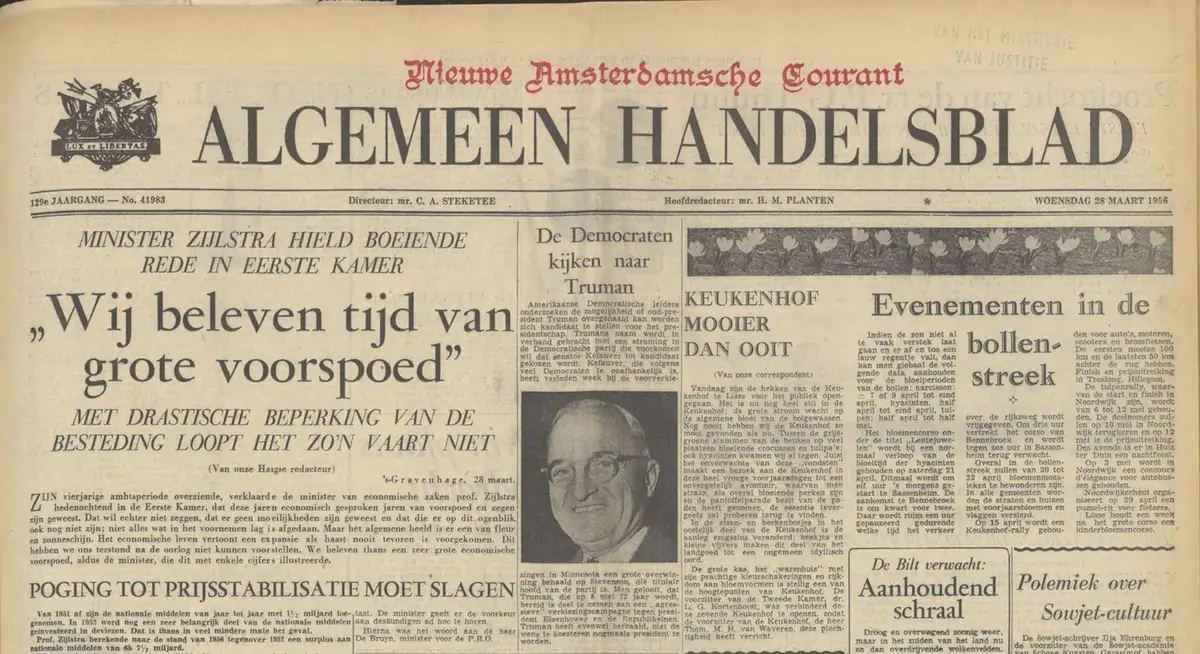
Though the name disappeared in 1970 when it merged to form NRC Handelsblad, its influence still shapes how the Netherlands reads, debates, and reports today.
1. From Waarenberichten (1825) to Algemeen Handelsblad (1828)
The paper’s roots reach back to 1825, when a bi-weekly circular called Waarenberichten (“Commodity Reports”) circulated among Amsterdam merchants.
On 5 January 1828, stockbroker J. W. van den Biesen expanded that modest sheet into a new daily under the name Het Algemeen Handelsblad, “The General Trading Paper.”
Its early mission was essential yet straightforward:
- Publish reliable information about trade, shipping, and the Amsterdam Stock Exchange.
- Serve professionals who needed facts, not politics.
At its birth, the paper mirrored the city itself, practical, profit-minded, and outward-looking.
2. Commerce Meets Commentary
As the nineteenth century advanced, Dutch society changed. Economic reporting alone no longer satisfied readers; public interest shifted toward politics, social reform, and global affairs.
The Handelsblad began covering debates in Parliament, colonial developments, and foreign policy, transforming itself from a narrow financial sheet into a national voice of liberal opinion.
This evolution wasn’t without tension. Some observers complained that a paper rooted in trade should avoid politics.
Later historians summarised the criticism as the claim that editors had “their feet in trade and their heads in politics”, an expression describing the dual loyalties that defined early modern journalism.
3. The Handelsbladgebouw – Cuypers’ Symbol of Modern Media
In 1903, the newspaper moved into an elegant new headquarters at Nieuwezijds Voorburgwal 234–240.
Designed by Eduard (Ed.) Cuypers, nephew of Rijksmuseum architect Pierre Cuypers, the Handelsbladgebouw embodied Amsterdam’s growing media confidence.
Its façade combined neo-Renaissance detail with practical newsroom layouts and state-of-the-art printing facilities.
The building became both an architectural landmark and a statement: journalism had joined the city’s institutions of trade, finance, and culture.

4. Expansion, Competition and Early Cooperation
By the late 1800s, dozens of newspapers competed for a finite readership. Printing technology improved, literacy rose, and advertisers sought broader audiences.
The Algemeen Handelsblad held its prestige, but competition intensified, especially from the Nieuwe Rotterdamsche Courant (NRC).
Reports suggest approaches between the two publishers in the 1910s and 1920s to explore cooperation on printing and distribution.
Though no merger materialised then, the idea of partnership lingered in Dutch media circles.
5. Post-War Change and the 1970 Merger
After the Second World War, Dutch journalism entered a new era.
Radio, then television, claimed much of the audience once devoted to newspapers. Advertising revenue declined, and multiple liberal dailies struggled to remain viable.
In response, the publishing group Nederlandse Dagbladunie decided to unite its two flagship titles.
On 1 October 1970, Het Algemeen Handelsblad and the Nieuwe Rotterdamsche Courant formally merged to create NRC Handelsblad, a single, liberal, quality newspaper serving the entire country.
This union preserved both papers’ editorial independence while ensuring financial stability and modernisation.
6. Language, Style and Influence
Throughout its history, Het Algemeen Handelsblad reshaped journalistic tone in the Netherlands.
- Accessible language: it abandoned the elitist phrasing of early financial journalism, writing for educated readers without jargon.
- Balanced reporting: commercial news coexisted with social, cultural, and political analysis.
- Editorial innovation: opinion pages and cultural supplements became regular features, now standard in quality newspapers.
Many later Dutch dailies adopted its clear prose and layout principles. Even today, NRC Handelsblad’s design lineage can be traced directly to its Amsterdam predecessor.

7. The Handelsblad in the Canon of Amsterdam
The newspaper is commemorated as Window No. 25 in the Canon of Amsterdam, a recognition reserved for institutions that shaped the city’s identity.
Its story encapsulates the shift from a merchant-city obsessed with shipping manifests to a democratic metropolis driven by debate and ideas.
8. Verified Facts & Enduring Relevance
| Aspect | Verified Information |
|---|---|
| Origin | Waarenberichten (1825) → first issue of Algemeen Handelsblad (5 Jan 1828). |
| Architect | Eduard Cuypers designed the 1903 headquarters. |
| Merger | Formed NRC Handelsblad on 1 Oct 1970. |
| Location | Nieuwezijds Voorburgwal 234–240, Amsterdam. |
| Editorial Legacy | Liberal orientation: foundation for modern NRC. |
By keeping these points precise and documented, the paper’s legacy remains a touchstone for accuracy and independence in Dutch media history.
Conclusion: A Trading Paper That Became a Cultural Institution
From the modest Waarenberichten circular to the national stature of NRC Handelsblad, Het Algemeen Handelsblad traces the very evolution of the Dutch press.
It captured the spirit of Amsterdam, enterprising, argumentative, outward-looking and proved that journalism could serve both commerce and culture.
Long after its presses stopped turning, its influence still prints itself across Dutch media: in the tone of today’s editorials, the architecture of newsroom buildings, and the conviction that accurate information sustains a free society.
Amsterdam as the World Book Capital: Written Legacy Continues
From the printing presses of the Algemeen Handelsblad to today’s thriving publishing houses, Amsterdam’s bond with the written word remains strong.
In fact, the city’s dedication to books, literacy, and culture earned it the title of World Book Capital, a modern celebration of the same creative energy that once powered its great newspapers.