Table of Contents
Introduction
In the closing months of the Second World War, the western Netherlands faced a catastrophe unlike any other experienced by a modern European nation.
What unfolded between the autumn of 1944 and the spring of 1945 was not merely a food shortage but a systematic famine, created through occupation policy, bitter weather, and the collapse of transport networks.
Known in Dutch memory as the Hongerwinter, the Hunger Winter claimed thousands of lives, emptied pantries, froze homes, and pushed entire cities to the brink of collapse.
Yet beneath the hardship lies an equally powerful story of courage, cooperation, and enduring human resilience.
The Road to Famine: Strike, Blockade & a Bitter Winter
In September 1944, the Dutch government-in-exile called for a nationwide railway strike to cripple German movements. The strike succeeded militarily, but it triggered devastating consequences.
The German response was immediate: all food, coal, and fuel shipments to the western provinces were cut off.
With bridges damaged, rail lines sabotaged, and a harsh winter setting in early, the embargo soon pushed the region into full-scale famine.
Coal imports stopped completely. Gas and electricity were rationed to bare minimum levels. Apartments and canal houses in Amsterdam, Rotterdam, and The Hague turned ice-cold.
Daily food rations plummeted, from roughly 1,800 calories to as low as 400. For many families, even this was a luxury.
Life in the Cities: Fuel, Food and Barter in the Dark
As fuel reserves disappeared, desperate residents turned to drastic measures.
- Trees were cut down across parks and boulevards.
- Abandoned homes, often belonging to deported Jewish families, were stripped for floorboards, doors, and furniture to keep stoves alive for just a few more hours.
- Nights grew colder, darker, and longer.
Food shortages followed the same trajectory. Bread and potatoes became unattainable. Markets emptied.
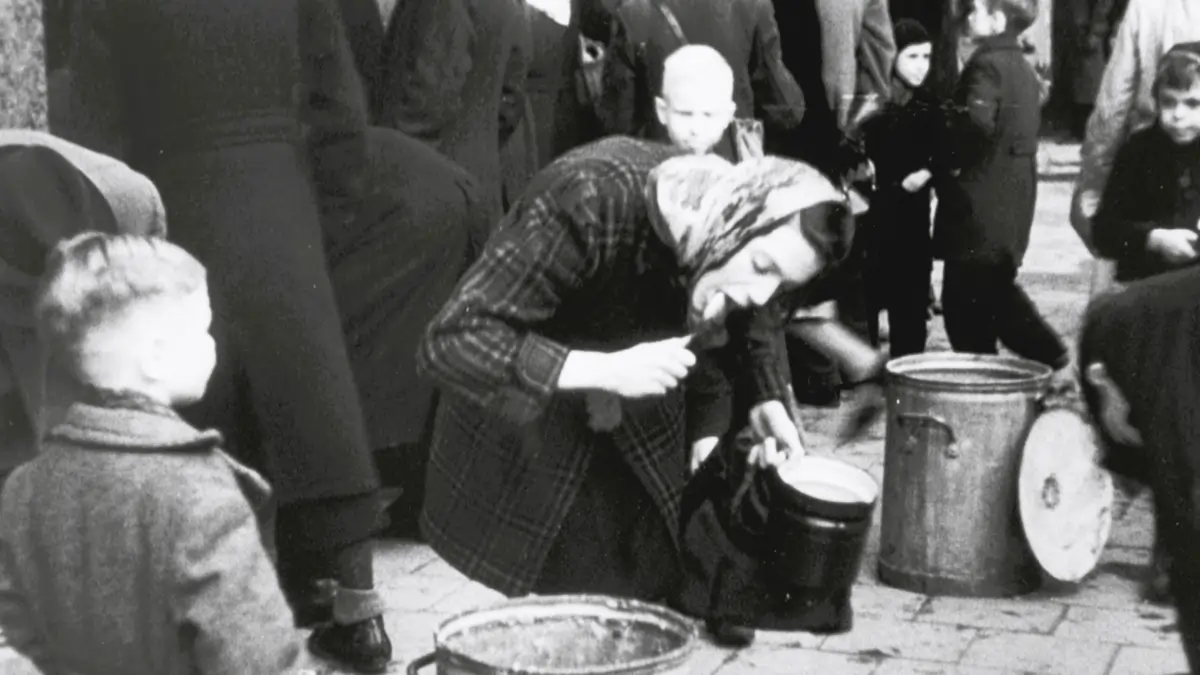
Mothers queued for hours in the winter cold to receive nothing more than a ladle of thin soup.
With currency useless, barter became the only economic system left. Family heirlooms, wedding rings, and silverware were exchanged for a few kilos of grain.
Beetroot and sugar beets became the main staple. And when even that ran out, people turned to tulip bulbs, bitter, chalky, and barely edible, but for many, the only thing that kept starvation at bay.
Rural–Urban Interactions: Hunger Treks and Checkpoints
When food stopped reaching the cities altogether, residents took matters into their own hands.
Thousands set out on hongertochten, or hunger treks, walking for days toward the northern and eastern provinces in search of farmers willing to trade.
These journeys were physically brutal and emotionally exhausting.
Travellers often faced:
- German checkpoints where food was confiscated
- Soldiers who were themselves hungry and desperate
- Frozen roads and blizzards
- The danger of returning empty-handed
Farmers were caught in their own moral dilemmas. Many offered help out of compassion; others demanded steep prices, knowing city dwellers had no choice.
These imbalanced exchanges created a complex relationship between the starving urban population and the tense, resource-stretched rural communities.
Community Resilience: Self-Help, Evacuations & Local Networks
While national systems struggled, local communities stepped up in remarkable ways.
Churches, neighbourhood committees, and volunteer networks organised clandestine food distribution, soup kitchens, and emergency childcare.
One of the lesser-known but profoundly impactful efforts was the evacuation of thousands of children from the worst-hit cities to the safer northern and eastern provinces. These journeys saved countless young lives.
In early 1945, against all odds, small international relief shipments arrived, including the famous Swedish white flour that brought temporary relief to starving families.
These grassroots and international efforts demonstrated the power of communal resilience even as the official state structures faltered.

Allied Relief & Liberation: The Final Push
As the war neared its end, the Allies launched two unprecedented humanitarian operations:
Operation Manna (British)
Low-flying RAF planes dropped food parcels over designated zones in the western Netherlands.
Operation Chowhound (American)
The U.S. Army Air Forces carried out similar drops, focusing particularly on Amsterdam and its surroundings.
These missions delivered thousands of tons of life-saving supplies. Many Dutch citizens still recall the roar of aircraft overhead, signalling not fear but hope.
Finally, on 4–5 May 1945, German forces surrendered, and the western Netherlands was liberated. The famine ended, but its effects would last for generations.
Long-Term Consequences: Health, Epigenetics & Memory
The Hunger Winter is now a foundational case study in global public health.
Researchers studying the Dutch Famine Birth Cohort discovered that children exposed to famine in the womb carried lifelong increased risks of:
- Heart disease
- Kidney disorders
- Type 2 diabetes
- Mental health issues
- Lower birth weights for their own children
Decades later, scientists now understand that famine can leave epigenetic marks, altering gene expression for generations.
The Hunger Winter thus stands as one of the most significant examples of how trauma can extend far beyond the moment of crisis.

Region Spotlight: How Different Areas Experienced the Famine
Amsterdam
As one of the most densely populated cities, Amsterdam suffered deeply from fuel shortages, frozen canals, and food scarcity. Hunger treks often began here.
Rotterdam
Already devastated by earlier bombings, Rotterdam faced compounded hardship when its remaining infrastructure collapsed under the blockade.
Northern & Eastern Provinces
These rural areas, Friesland, Groningen, Drenthe, Overijssel, were less affected by direct famine and became lifelines for evacuees and urban barter travellers.
Differences in geography, population density, and local governance shaped each region’s experience of the Hunger Winter.
Why It Matters Today: Lessons & Legacy
The Hunger Winter is more than a chapter of Dutch history; it is a warning and a guide for future generations.
It teaches us that:
- Food supply systems are fragile and can collapse rapidly.
- Energy and heating are essential for survival, not luxuries.
- Community networks are vital when government structures fail.
- Short-term crises can create lifelong and intergenerational health effects.
The Hunger Winter remains a powerful symbol of how ordinary people endured extraordinary hardship and how resilience can flourish even in the darkest of times.
Frequently Asked Questions (FAQ)
Q: What caused the Hunger Winter of 1944–45?
A: A combination of the Dutch railway strike, the German embargo on food and fuel, severe winter weather, and extensive wartime damage to the transport network.
Q: How many people died during the famine?
A: Around 20,000 people died from starvation-related causes, most of them in the western provinces.
Q: What foods did people rely on to survive?
A: Beetroot, sugar beets, potato skins, and tulip bulbs became common survival foods. Bartering valuables for small quantities of grain was widespread.
Q: What were the long-term health effects?
A: Increased rates of cardiovascular diseases, diabetes, kidney disorders, and epigenetic changes affecting the next generation.
Q: How did Amsterdam’s experience differ from rural areas?
A: Amsterdam faced a complete collapse of heating and food distribution. Rural regions, while pressured, often had more access to agricultural goods and became destinations for evacuees.