Among the fifty stories chosen for the Canon of Amsterdam, a collection celebrating the city’s defining historical moments, one event stands out for its destructive power and lasting impact: the Great Fire of 1421.
Though the Canon’s numbering may differ by edition, this fire remains one of Amsterdam’s most significant early disasters.
Together with the even greater blaze of 1452, these two events reshaped the city’s architecture, laws, and identity, transforming Amsterdam from a medieval town of timber to a metropolis built on brick and resilience.
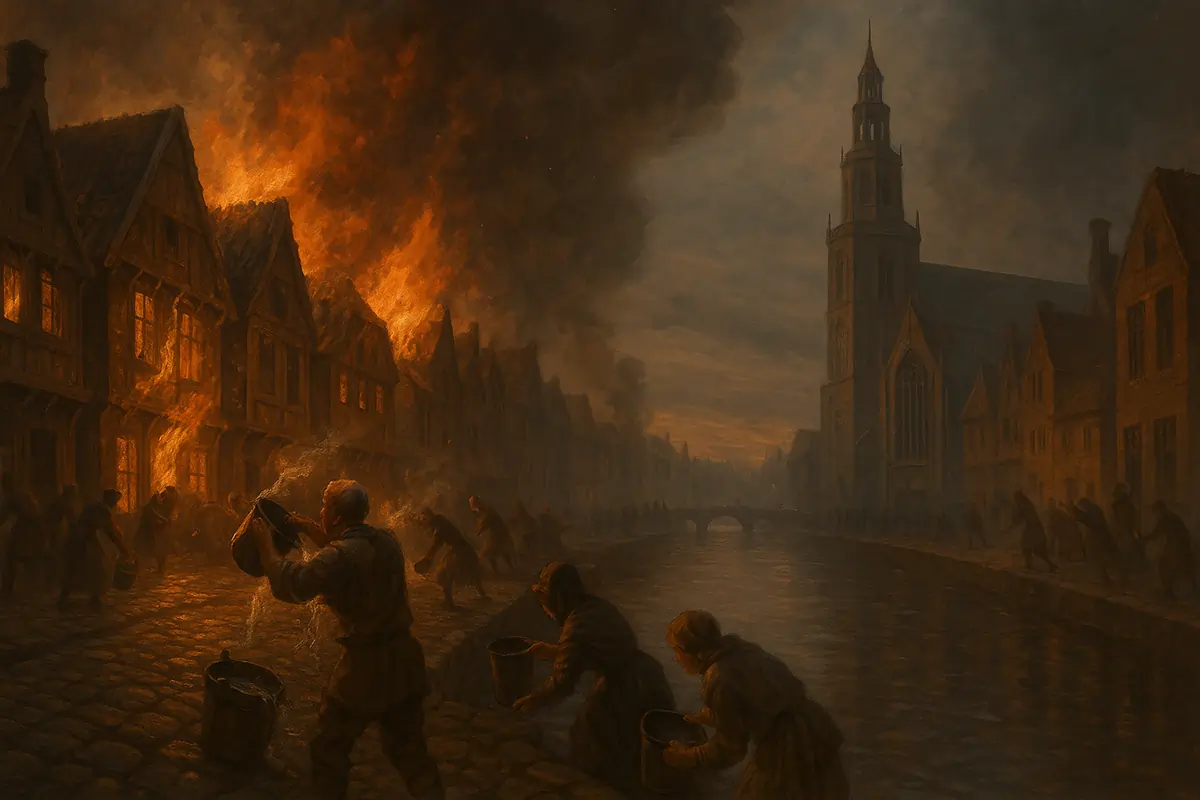
Table of Contents
Life in Medieval Amsterdam: A City Built to Burn
In the 15th century, Amsterdam was growing quickly along the Amstel River. Yet its prosperity came with peril.
The city’s narrow streets were lined with timber-framed houses, most covered in thatched roofs of reed or straw.
Inside, open hearths burned continuously for cooking and heat, while candles provided light. Chimneys existed but were rare and costly to maintain.
It was a dangerous combination: a dense wooden town with no professional fire brigade and limited access to water.
A single ember could mean catastrophe. And in 1421, it did.
The Great Fire of 1421: Amsterdam’s First Great Inferno
Little is known about how the 1421 fire began, but its impact was devastating. The flames spread rapidly through Amsterdam’s tightly packed streets, driven by wind and dry materials.
When the smoke cleared, roughly a third of the city had been destroyed. Entire blocks vanished overnight, homes, shops, and warehouses turned to ash.
For a city just beginning to establish itself as a trading hub, the blow was immense.
The fire joined a long list of similar medieval disasters across Europe: Rome burned in 64 AD, Constantinople suffered repeated infernos, and London and Utrecht had each burned multiple times.
City fires were tragically ordinary, yet each one forced communities to rebuild, rethink, and evolve.
Lessons Forgotten: The Calm Before the Next Fire
After the 1421 fire, Amsterdam was rebuilt much as before. Wooden houses rose again, with thatched roofs and open fires, the same materials, the same risks.
While prayers and church processions marked the city’s repentance, no major building reforms were enacted.
Amsterdam remained a beautiful but fragile settlement. It was only a matter of time before disaster struck again.
The Great Fire of 1452: The Blaze That Changed Everything
In May 1452, a second great fire erupted in Amsterdam. Strong winds turned a small blaze into a citywide inferno that raged for two days. By the end, about three-quarters of Amsterdam was gone.
Contemporary records describe “streets of glowing embers” and warehouses bursting into flames as tar and oil caught fire.
The damage dwarfed that of 1421 and left thousands homeless. Even the city’s economy, heavily dependent on trade and shipping, was paralysed.

After the Flames: Amsterdam’s Slow Transformation
In the wake of the 1452 fire, city authorities encouraged the use of brick and sought to reduce the use of flammable materials.
Rules were drafted calling for brick firewalls between houses and discouraging thatched roofs.
However, it’s important to note that these reforms were not enforced immediately. Timber construction remained dominant for decades.
Only in the early 16th century, around 1521, did the process of “petrification” begin in earnest, as brick and stone gradually replaced wood in new construction.
By the late 1500s, Amsterdam had begun to take on the sturdier, more fire-resistant look we recognise today.
The Last Wooden Houses of Amsterdam
Though few survive, Amsterdam still preserves two rare wooden structures, silent witnesses to its medieval past.
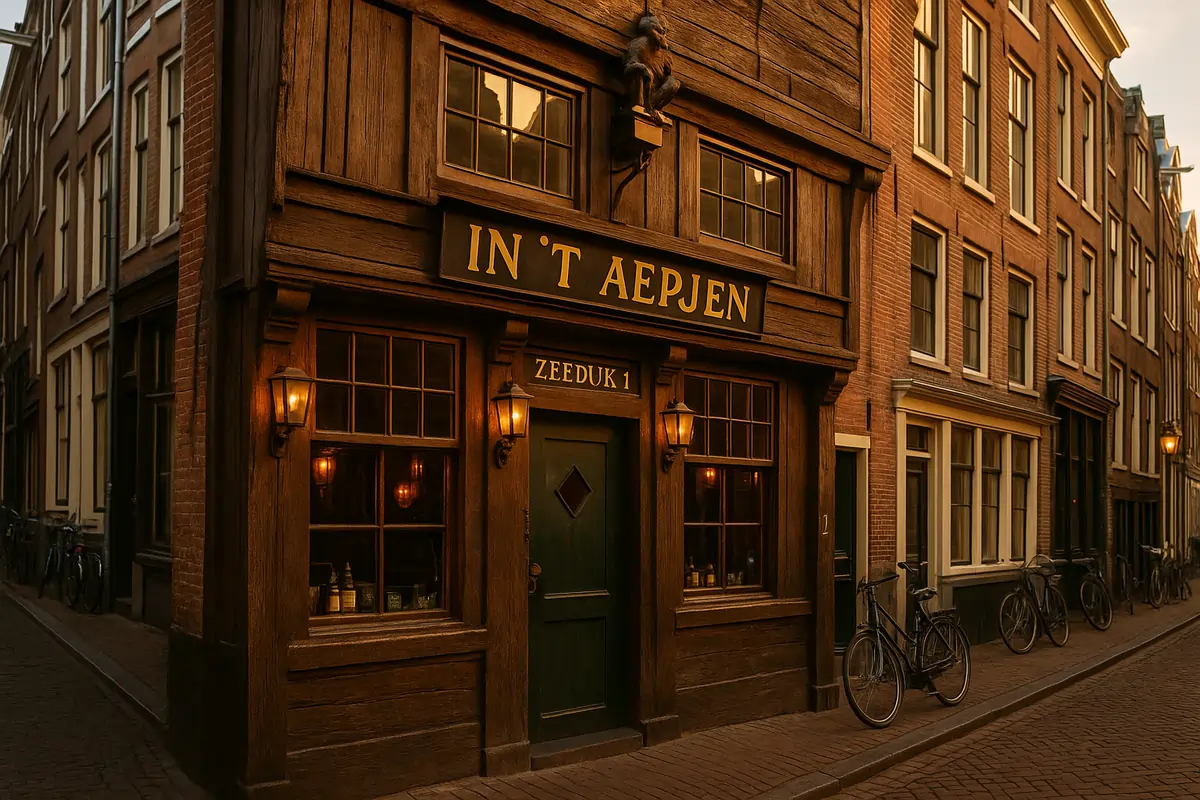
- Café In ’t Aepjen, on the Zeedijk, is one of Amsterdam’s oldest wooden buildings. Most reliable sources date the current structure to between 1546 and 1550. Legend says sailors once paid their bills here with exotic monkeys, giving the café its name (“In the Little Monkey”).
- The Houten Huys at the Begijnhof, dating to around 1528, is another rare survivor. Built in the late Gothic style, it represents a transitional phase, timber-framed but already influenced by the growing trend toward masonry.
Both buildings reflect Amsterdam’s architectural evolution: remnants of a wooden past, preserved amid a city that rose, literally, from its ashes.
Building on Water: The Invention of Pile Foundations
As Amsterdam rebuilt in brick, a new problem arose: weight. The city’s soft, marshy soil couldn’t support heavy stone structures.
The solution was ingenious: drive wooden piles vertically into the wet ground to anchor buildings deep into the sandy layers below.
This practice began in the late Middle Ages and continues, in updated form, to this day.
It allowed Amsterdam to expand safely, supporting grander and taller architecture.
The Royal Palace on Dam Square, built between 1648 and 1665, famously rests on 13,659 wooden piles, a symbol of both ingenuity and endurance.
Yet, there’s a modern caveat: these piles only remain stable while submerged.
If exposed to oxygen through drained groundwater (for instance, during major projects like the North–South metro line), they can rot, threatening the stability of historic structures.
The Miracle of Amsterdam: Faith Amid the Flames
Amid these disasters, one story stood apart: the Miracle of Amsterdam.
In 1345, a dying man’s consecrated Host was said to have miraculously survived the flames after being thrown into a fire.
The event became one of Amsterdam’s most cherished religious legends, and the sacred Host was preserved in the Old Church (Oude Kerk).
Remarkably, the Oude Kerk survived both the 1421 and 1452 fires largely unscathed.
For believers, it was a divine sign that the miracle continued to protect the heart of the city even as flames consumed everything around it.
From Flames to Foundations: The Legacy of the Fires
The great fires of 1421 and 1452 were catastrophic, but they also marked the birth of the modern city.
From those ashes came lessons in urban planning, engineering, and safety that defined Amsterdam’s character for centuries.
- They exposed the dangers of wooden urban density.
- They prompted the long shift toward brick and tile architecture.
- They inspired better fire prevention and city design.
- And they gave rise to the foundation techniques that made Amsterdam’s canal houses possible.
By the 17th century, Amsterdam had evolved into one of Europe’s most beautiful and well-planned capitals, a transformation built, quite literally, on the lessons of fire.
Key Takeaways
- 1421 Fire: Destroyed about one-third of Amsterdam.
- 1452 Fire: Burned roughly 75% of the city.
- Reforms: Encouraged brick use and banned thatch, though true enforcement began decades later.
- Architecture: Wooden houses were gradually replaced by brick buildings from the 1520s onward.
- Survivors: Café In ’t Aepjen (c. 1546–1550) and the Houten Huys at Begijnhof (c. 1528).
- Miracle: The Oude Kerk survived both fires, a lasting symbol of faith and endurance.
Where to See the History Today
Visitors to modern Amsterdam can still experience the echoes of this fiery past.
Walk the Zeedijk to see Café In ’t Aepjen, step into the peaceful Begijnhof courtyard to view the Houten Huys, or visit the Oude Kerk, the church that twice survived disaster.
These landmarks remind us that the Amsterdam we know today, with its canals, brick houses, and elegant gables, was born not from fortune, but from resilience.