Table of Contents
How Did Amsterdam Create One of the Most Influential Civic Buildings of the Seventeenth Century?
By the mid-seventeenth century, Amsterdam had risen to a level of economic and political importance unmatched by most European cities.
Its trade networks stretched across the world, its population expanded rapidly, and its merchants held significant influence.
Within this context, the old medieval town hall on Dam Square no longer reflected the city’s stature.
Built from earlier monastic structures and altered many times, it lacked coherence, space and symbolic power.
City leaders decided that a new civic building was necessary to embody confidence, order and public authority.
In 1648, the same year peace was secured after decades of conflict, the first stone of the new town hall was laid.
The project represented civic ambition as much as practicality. The old hall was removed to make space for a building that would serve as the administrative centre of a thriving republic.
It aimed to express ideals of justice, stability and commercial reach through architecture and art.
Who Designed the New Town Hall and What Vision Guided the Project?
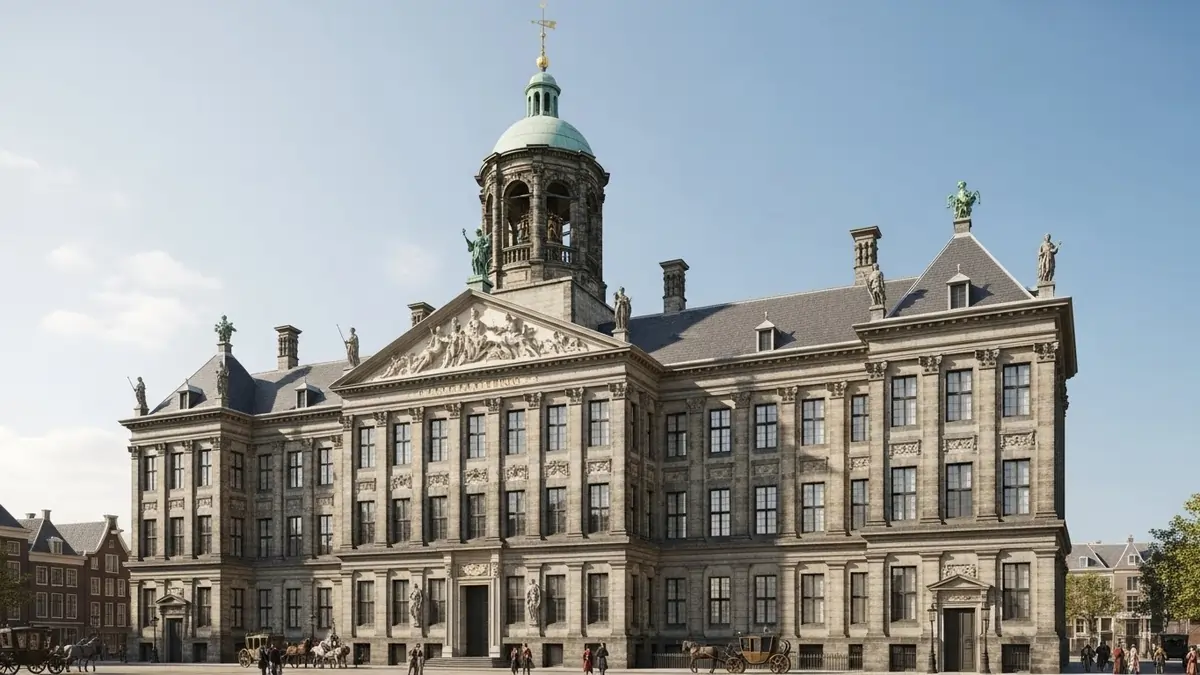
Jacob van Campen, one of the foremost architects of his time, was selected to lead the project.
His design followed classical principles of symmetry and proportion while adapting them to Dutch traditions.
He created a structure that conveyed order and civic virtue rather than aristocratic display.
The building was conceived as a public expression of Amsterdam’s governance model, which valued disciplined administration and collective responsibility.
Dutch Classicism suited these aims. Instead of intricate ornamentation, the building relied on clear lines, balanced masses and controlled decorative programs.
Its stone facade and unified form distinguished it from the narrow brick buildings typical of the city, signalling a shift in architectural aspirations.
How Did Builders Overcome the Challenge of Amsterdam’s Ground Conditions?
Amsterdam sits on soft, waterlogged soil. Constructing such a large building required an inventive approach to foundations.
Thousands of wooden piles were driven deep into the ground to support the weight of the hall. This stabilised the site and allowed the structure to rise with confidence.
Without this foundation system, a building of this scale would have been impossible on Dam Square.
These efforts demonstrated the city’s technical capabilities and its willingness to invest heavily in civic infrastructure.
The foundation alone involved logistical planning that matched the ambition of the architectural design.

When Was the Building Completed?
The new town hall opened to the public in 1655, allowing the city to begin using its courts, council chambers and administrative rooms.
Interior decoration and some structural work continued after the opening.
Modern scholarship often references a completion date in the mid-1660s to reflect this extended period of finishing work.
This distinction helps explain variations in reported dates.
Regardless of which date is highlighted, the building quickly became known across Europe for its monumental scale and clarity of design.
How Did the Interior Reflect the Ideals of Civic Government?
The interior was carefully planned to illustrate the responsibilities of public office and the priorities of a commercial republic.
The central Citizens Hall, one of the largest civic spaces in Europe, made an immediate impression with its marble floors, tall windows and soaring height.
Inlaid maps depicted the known world, affirming Amsterdam’s global presence and reminding visitors that trade connected the city to distant regions.
Rooms surrounding the hall served the daily functions of municipal administration. Magistrates, treasurers, record keepers and judicial officials all worked within this complex.
Themes of fairness, duty and public order appeared in sculptural and painted programs throughout the building.
Artists of considerable skill participated. Ferdinand Bol and Govaert Flinck contributed major works that linked artistic achievement to civic identity.
Rembrandt also produced a large painting associated with the project.
His work did not remain in place and was removed early, but his involvement underscores the building’s significance within the Dutch artistic community.

Why Was the Town Hall Considered a Major Civic Achievement?
The building represented an idealised vision of republican governance. Rather than glorifying a single ruler, it elevated the authority of institutions and the collective responsibilities of the city.
Its design and decorative choices reinforced the concept of just administration and open public life.
Travellers and writers praised the town hall for its architecture as well as its symbolic clarity.
It stood among the most impressive civic structures in Europe and reflected the city’s confidence during the height of its commercial power.
How Did the Town Hall Become a Royal Palace?
For roughly one hundred fifty years, the building served administrative functions.
This changed in 1808 when Louis Napoleon, appointed King of Holland, selected the hall as his official residence.
Its scale and central location suited his needs, and he ordered alterations that adapted some rooms for royal use.
A balcony was added to the facade. Residential suites and ceremonial rooms replaced parts of the original civic layout.
Although his tenure was brief, this change redefined the building’s identity. After the end of Napoleonic rule the building retained its association with the monarchy.
It was no longer the centre of municipal government but gradually took on a ceremonial and representative role within the national context.
When Did Amsterdam Become the Capital and What Does That Designation Mean?
Amsterdam was recognised as the capital in 1814 during the formation of the new Dutch state.
This designation had constitutional significance but did not shift the practical seat of government away from The Hague.
The title affirmed Amsterdam’s symbolic importance, its cultural weight and its historic role in national identity.
Capital status, however, was not tied to a transfer of ownership of the former town hall. That process unfolded much later.
When Did the Palace Become State Property?
The building formally became property of the national state in 1936. Prior to this, it had been used by the monarchy for official functions, but the legal structure of ownership had remained ambiguous.
The 1936 transfer clarified its status and secured its maintenance as part of the national heritage.
This change did not alter its function dramatically. The palace continued to host receptions, royal events and public visits.
It solidified its role as a ceremonial asset rather than a residential palace.
What Role Does the Royal Palace Serve Today?
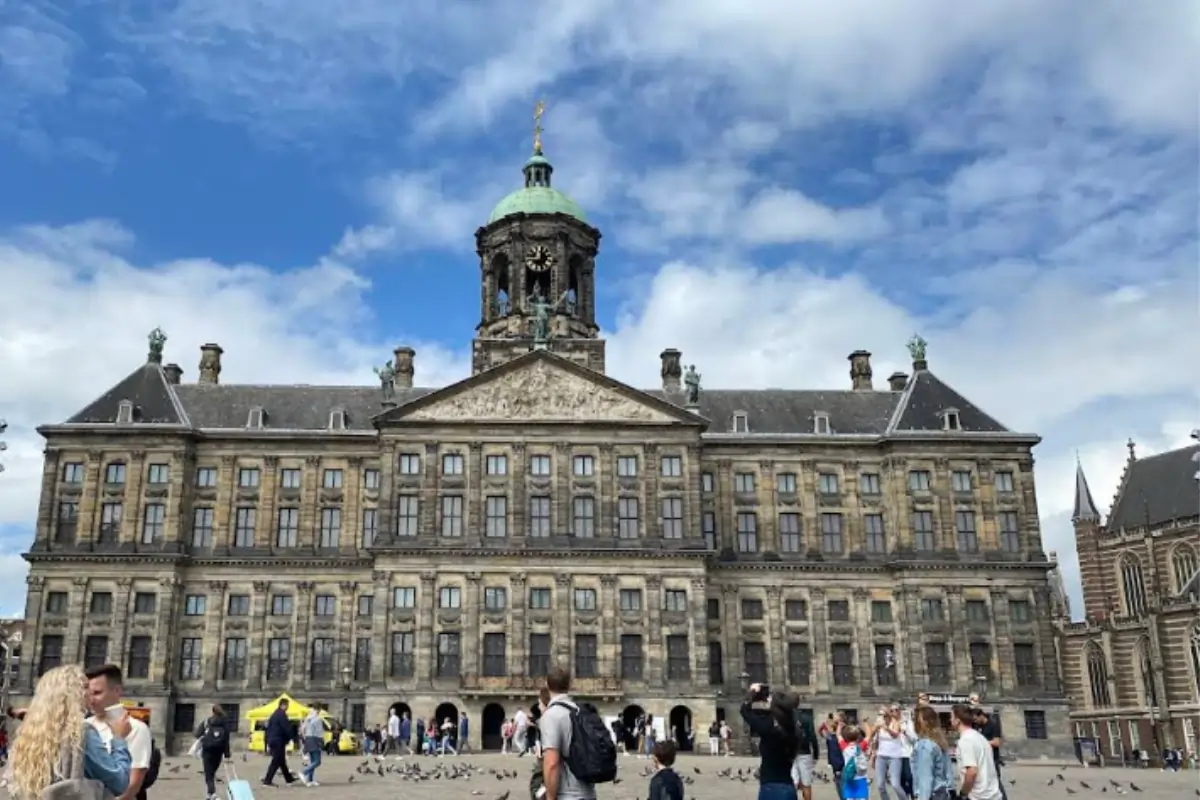
Today, the palace remains an active component of Dutch public life. It hosts state receptions, official ceremonies, award presentations and royal guests.
When not in use for these events, portions of the building open to visitors who wish to explore its historic interiors.
The preserved halls allow guests to view the sculptural programs, large-scale paintings and the memorable Citizens Hall.
Exhibitions provide historical context and highlight the evolution of the building from a republican centre of power to a royal ceremonial site.
Why Does the Building Hold Continuing Importance?
The Royal Palace embodies several strands of Dutch history. Architecturally, it reflects the height of seventeenth-century civic planning.
Artistically, it gathered leading painters and sculptors into a unified program.
Politically, it mirrors transitions from a merchant republic to a modern monarchy. Culturally, it remains one of Amsterdam’s defining landmarks.
Its ability to adapt across centuries without losing its symbolic presence makes it a rare and important monument.
Visitors encounter a structure that once held the daily workings of a thriving republic and now hosts national ceremonies, yet still carries the clarity and ambition of its original design.
FAQ
Q. Why was the old town hall replaced?
It no longer matched the scale, needs and authority of a rapidly growing city. A new structure was required to house courts, administration and public functions.
Q. When was the town hall opened?
It opened for use in 1655, although decorative and structural work continued into the 1660s.
Q. Did Rembrandt contribute to the building?
Rembrandt created a painting associated with the project, although it was removed early and did not remain part of the permanent program.
Q. When did the building become a royal palace?
In 1808, when Louis Napoleon chose it as his residence during his rule as King of Holland.
Q. When did it become state property?
Ownership transferred to the national state in 1936.
Q. Does the monarchy still use it?
Yes, it serves ceremonial and official functions and opens to the public when events permit.
What Other Institutions Shaped Public Order in Amsterdam?
The new town hall represented the city’s ideals of justice and responsible governance.
These values were also reflected in other institutions that handled discipline and social control.
One of the most significant was the House of Correction, where authorities dealt with offenders, vagrants and individuals sentenced to forced labour.
This facility formed an important part of Amsterdam’s wider system of regulation and public oversight.