Table of Contents
Why Is Amsterdam Known as the City of Diamonds?
Diamond is a rare crystallised form of carbon valued for its strength and light performance.
When a rough stone is polished by skilled hands, its brilliance becomes the hallmark that people associate with luxury and precision.
Amsterdam worked with diamonds for more than four hundred years and became one of the most recognised diamond centres in the world.
Its story includes migration, technology, labour movements and international trade.
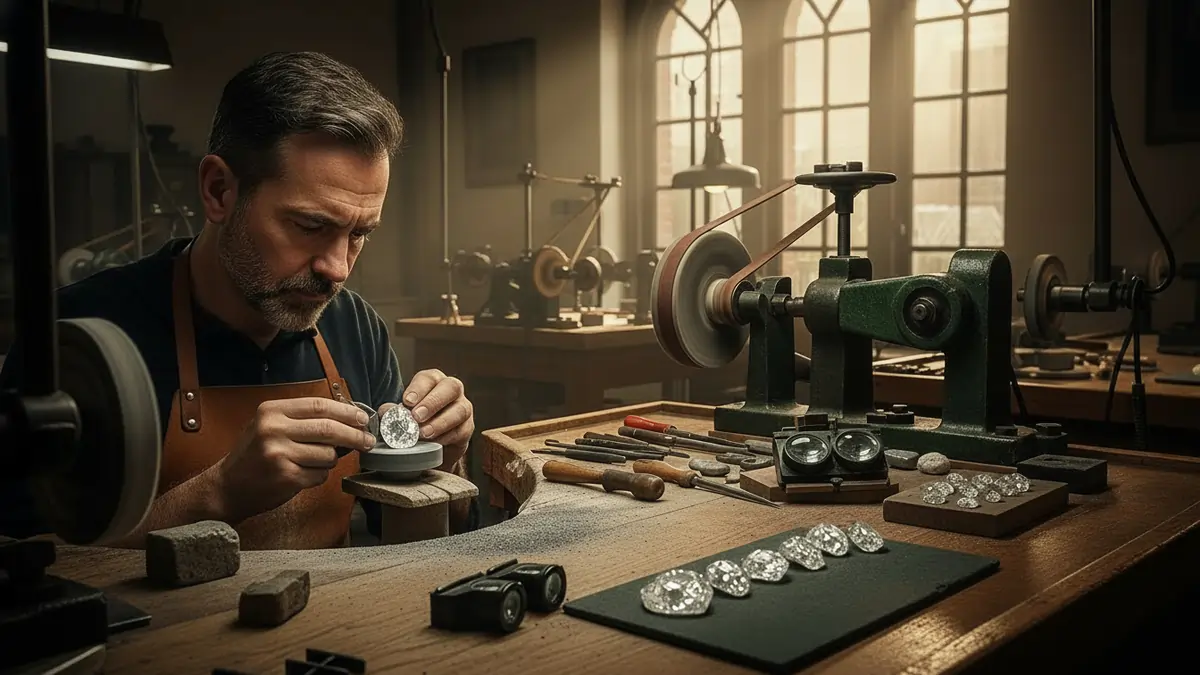
When Did Diamond Cutting Begin in Amsterdam?
Records show that a diamond cutter was registered in Amsterdam in 1586.
This early presence grew into a significant industry during the seventeenth century.
After the fall of Antwerp in 1585, many trained craftsmen moved north to Amsterdam seeking stability and an environment where their skills were welcomed.
Amsterdam’s relatively tolerant laws also attracted Protestant and Sephardic Jewish communities who had limited opportunities elsewhere.
Because many trades required guild membership, which often excluded Jews, diamond cutting became an accessible professional path.
This created a skilled workforce that shaped Amsterdam’s reputation for quality.
What Helped Amsterdam Become a Global Diamond Centre?
Several key factors supported the city’s rise.
Access to raw stones
Trade routes brought rough diamonds from India through Portuguese networks.
Supplies expanded when deposits were discovered in Brazil during the eighteenth century and later in South Africa during the nineteenth century.
These sources kept Amsterdam’s workshops active.
Technological progress
Steam power changed diamond polishing.
- In 1840, the firm of Hont introduced the first steam-driven polishing factory in Amsterdam.
- Around 1845, Martin Coster replaced horsepower with steam engines at his workshop, which strengthened industrial capacity.
These changes supported larger output and consistent quality.
An experienced workforce
By the nineteenth century, thousands of diamond workers were employed across the city.
Their skills and attention to detail created a level of craftsmanship that became internationally recognised.

International trust
Merchants from across Europe valued the precision associated with Amsterdam’s cutters.
This reputation supported both trade and training.
How Did Amsterdam Influence the Development of Modern Diamond Craft?
Amsterdam helped standardise early expectations for symmetry, proportion and polish.
Many workers trained apprentices who later contributed to diamond work in other countries.
The city also became a central meeting point for traders and buyers, helping shape consistent commercial practices.
Through these contributions, Amsterdam influenced both the artistic and practical understanding of diamond cutting.
How Did Labour Movements Shape the Industry?
As the industry expanded, so did the need for organised representation.
In 1894, the General Dutch Diamond Workers Union (ANDB) was formed to address working conditions, income stability and fair negotiation.
The union was notable because it included both Jewish and non-Jewish workers.
It provided structure in a period when many trades lacked formal representation.
Its work also encouraged cultural participation and educational access for its members.

Labour Movements Shape the Industry
Who Was Henri Polak?
Henri Polak was a central figure in the development of the diamond workers’ union.
He was active in national politics, supported voting rights for women and promoted cultural enrichment.
He served in the national parliament and in two local councils, one in Amsterdam and another in the municipality of Laren.
Polak’s influence extended beyond the diamond trade. He supported improved labour conditions, shorter workweeks and access to arts and culture for the general public.
His leadership shaped both the union and broader social policy.
What Changed for the Diamond Trade in the Twentieth Century?
Amsterdam continued to thrive through the early twentieth century, but the Second World War brought a severe decline.
Many Jewish workers, who formed the backbone of the industry, were deported. This caused the loss of a highly specialised workforce.
After the war, some activity resumed, and certain diamonds were recovered and returned.
However, global diamond processing shifted to regions with lower production costs.
By the mid twentieth century, Amsterdam’s primary role had changed from mass manufacturing to heritage, tourism and specialised retail.
Why Does Amsterdam Still Carry the Title City of Diamonds?
Although most polishing now takes place in other countries, Amsterdam remains strongly connected to diamond history.
Visitors can watch modern cutters at work, explore historical workshops and learn the full story from geological origins to global trade.
The Diamond Museum in Amsterdam presents tools, techniques, historical documents and replicas of important stones.
It preserves the legacy of a craft that shaped the city for centuries.

Which Famous Diamonds Are Connected to Amsterdam?
It is important to distinguish between diamonds actually handled in Amsterdam and diamonds mentioned for the general context.
Diamonds verified as cut or polished in Amsterdam:
- Koh-i-Noor
- Several stones handled by historic workshops, such as Coster, though exact lists vary by period
Famous diamonds often referenced in diamond history, but not confirmed as cut in Amsterdam:
- Star of Africa
- Darya ye Noor
- Shah Diamond
- Florentine Diamond
- Jacob Diamond
- The Promise of Lesotho
Including both groups provides historical breadth, but only verified stones are attributed to Amsterdam’s cutters.
What Are Conflict Diamonds?
Conflict diamonds refer to stones sold to support armed groups or political violence.
International pressure led to tighter regulation, and trade in such stones is prohibited.
Modern certification systems aim to ensure that diamond supply chains operate responsibly.
Why Is a Sixty Year Marriage Called a Diamond Wedding?
A diamond wedding marks sixty years of marriage.
The term reflects the qualities associated with the gemstone, which include rarity, endurance and strength.
How Can Visitors Explore Amsterdam’s Diamond Story Today?
Visitors can take tours through active polishing workshops, follow walking routes along historic diamond sites and learn about the entire process at the Diamond Museum.
These experiences highlight the city’s enduring connection to the craft.
Frequently Asked Questions
Q. When did Amsterdam become involved in the diamond trade?
Activity began in the sixteenth century and expanded rapidly in the seventeenth and nineteenth centuries.
Q. Why were Jewish workers central to the trade?
Guild restrictions limited opportunities in other professions. Diamond cutting was open to workers of all backgrounds, which allowed Jewish craftsmen to build strong communities within the trade.
Q. Did Amsterdam remain a major diamond manufacturer?
No. Most polishing shifted abroad during the mid-twentieth century. Amsterdam now focuses on heritage, training and retail.
Q. Can visitors watch diamond cutting in Amsterdam?
Yes. Selected workshops offer live demonstrations of modern polishing techniques.
Q. Which famous diamond was definitely cut in Amsterdam?
The Koh-i-Noor is the most famous example with confirmed links to Amsterdam’s workshops.
Q. Did steam power shape the industry?
Yes. The first steam-driven polishing factory began in 1840, and Coster introduced steam power in the mid-1840s, increasing efficiency and production.
Q. Did Henri Polak serve outside Amsterdam?
Yes. He served in the Amsterdam council and later in the municipal council of Laren.
Q. What makes Amsterdam’s diamond history stand out?
It reflects a unique blend of migration, tolerance, skilled craftsmanship, labour organisation and international trade influence.
How Does Amsterdam’s Diamond Story Connect to Its Cultural Status?
Amsterdam’s history with diamonds reflects a long tradition of skilled work, creativity and intellectual curiosity.
These qualities also shaped the city’s cultural development.
For visitors interested in how Amsterdam influenced global arts and knowledge, its selection as World Book Capital highlights another part of this heritage.