Table of Contents
What does the Oldest Account Book connected to Amsterdam refer to?
The Oldest Account Book refers to a surviving late-15th-century merchant ledger associated with Amsterdam traders Symon Reyerszoon and Reyer Dircszoon.
For visitors, it matters because it is used as an example of early commercial record-keeping in Amsterdam at a time when very few written sources from the city survive.
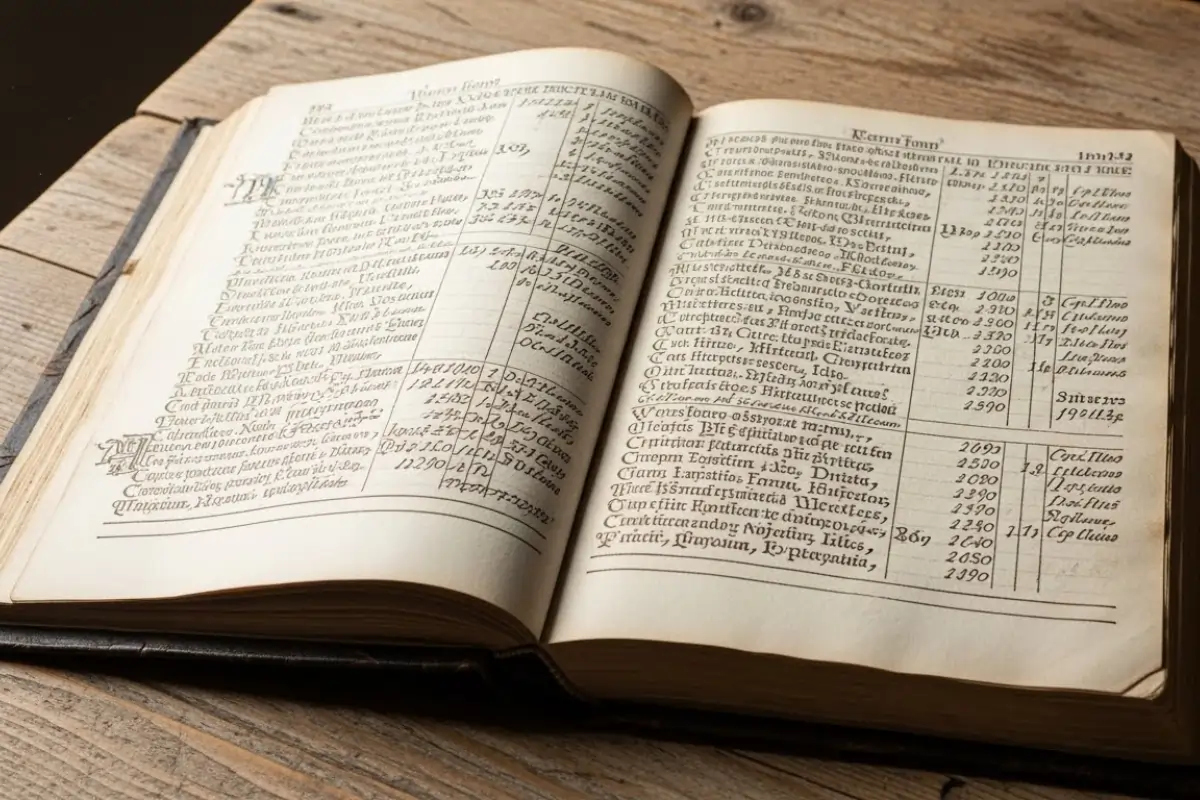
Why is the Oldest Account Book included in the Canon of Amsterdam?
The account book is included because it demonstrates that Amsterdam merchants were already recording trade activity in writing during the late 15th century.
Its value lies in its survival rather than in the volume or clarity of information it contains.
From an editorial planning perspective, the Canon uses the document to illustrate early administrative practice, not to present a complete picture of Amsterdam’s economic development.
How is the account book understood today?
The account book is understood through later historical research and interpretation rather than through the ledger alone.
The original entries are brief and require contextual explanation to be meaningful to modern readers.
What role does N. W. Posthumus’s play in research on early Amsterdam trade?
N. W. Posthumus is widely recognised for his academic work on Dutch economic and trade history.
His broader research into medieval and early modern commerce provides important background for understanding documents such as the Oldest Account Book.
Based on widely cited academic literature, Posthumus’s mid-20th-century publications are often used to situate Amsterdam’s limited surviving records within a wider European context.

How has the historical value of the account book been discussed?
The historical value of early Amsterdam merchant records has been discussed in academic and historical journals, including Amstelodamum, published by the Genootschap Amstelodamum.
These discussions generally emphasise that such documents offer partial insight rather than comprehensive explanations.
This is a frequent point of confusion for visitors, as the Canon reference may suggest a level of detail that the original material lacks.
What information does the account book actually contain?
The account book consists mainly of short transactional notes rather than narrative descriptions.
Its contents allow limited conclusions based on recorded activity.
The entries typically relate to:
- Goods traded by Amsterdam merchants.
- Basic price references linked to Baltic commerce.
- Notes associated with ports, such as Danzig (modern Gdańsk).
The document does not explain broader political, social, or economic conditions on its own.
Why are non-Dutch sources often used alongside this account book?
Many comparable merchant records from the same period survive in German and Baltic archives.
Historians use these sources to supplement Amsterdam material, helping to clarify trade practices that the local records only hint at.
This comparative method is standard in research on late-medieval European commerce.
Where can visitors learn more about this period of Amsterdam’s history?
Visitors interested in early trade and administration can explore institutions that interpret Amsterdam’s development within a wider historical framework:
- Amsterdam Museum, which presents the city’s history from medieval origins onward.
- The Canon of Amsterdam is displayed across museums and cultural venues.
- Library and archive exhibitions that focus on urban and economic history.

Is the original account book available for public viewing?
There is no consistent public display of the original account book.
Like many late-medieval documents, it is primarily referenced through publications and interpretive material rather than as a regularly exhibited object.
FAQs
Is the Oldest Account Book a museum attraction?
No. It is a historical source referenced through interpretation rather than a stand-alone exhibit.
Does the account book explain how Amsterdam became a major trading city?
No. It provides limited transactional evidence and must be combined with other sources.
Why is the account book still mentioned today?
It survives as rare written evidence from a period with very few Amsterdam merchant records.
Where can visitors see related historical context?
Context is provided through the Canon of Amsterdam displays and city-history museums.
Summary
This guide supports visitors interested in how Amsterdam’s early commercial history is reconstructed from scarce documentation.
The Oldest Account Book is significant because it shows that written trade records existed in late-15th-century Amsterdam.
Visitors gain the clearest understanding by viewing it within broader historical exhibitions rather than as an isolated document.
Where can visitors explore Amsterdam’s history beyond written sources?
Visitors interested in early trade records often benefit from seeing how Amsterdam’s broader history is interpreted in physical museum settings.
City museums provide a structured context that helps explain how limited documentary sources, such as merchant account books, fit into broader social and economic developments.
For practical planning, an overview of museums in Amsterdam helps visitors identify institutions that cover medieval commerce, urban administration, and long-term city growth in accessible exhibition formats.
This approach allows visitors to move from abstract historical references to curated displays that explain Amsterdam’s development in a clearer, place-based way.