Table of Contents
Introduction: Amsterdam’s Most Misunderstood Neighbourhood
Few places in the world are as instantly recognisable or as debated as Amsterdam’s Red Light District, locally known as De Wallen.
It isn’t just a spectacle of neon windows; it’s one of the oldest inhabited areas of Amsterdam, where commerce, morality, and regulation have intertwined for more than 700 years.
Understanding De Wallen means understanding Amsterdam itself: a city whose foundations rest on freedom managed through law rather than repression.
Where Is the Red Light District?
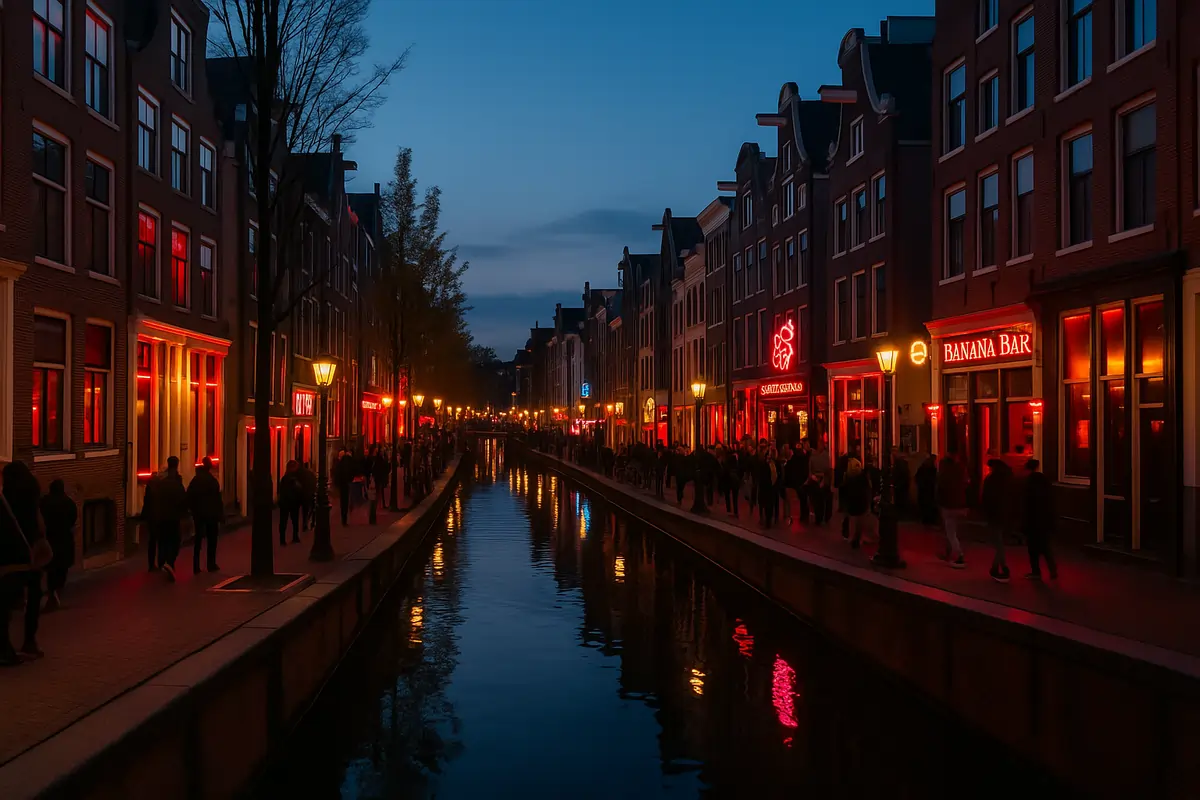
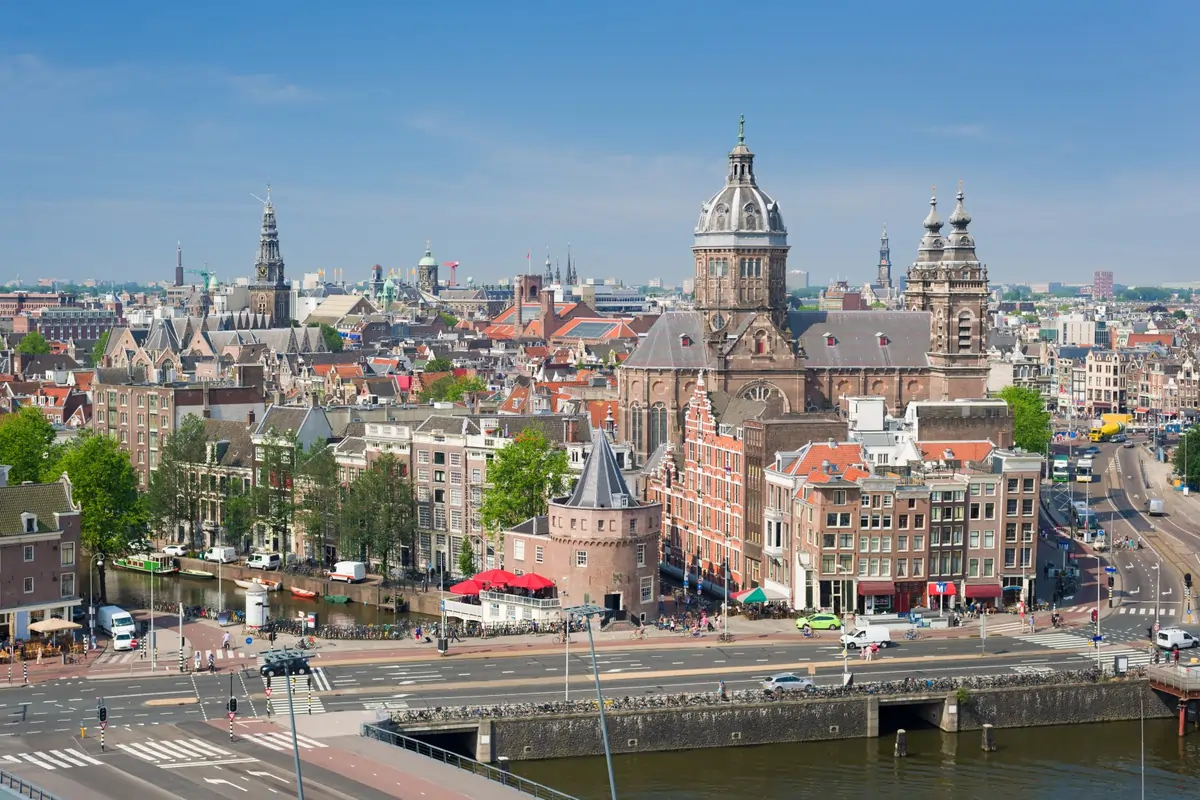
De Wallen lies around the Oude Kerk (Old Church) in the city’s medieval core, bordered roughly by Dam Square to the west and Nieuwmarkt to the east.
Two main canals, Oudezijds Achterburgwal and Oudezijds Voorburgwal, form its backbone.
The district is compact, walkable, and full of contrasts: historic façades beside modern cafés, residents beside tourists, centuries-old chapels beside glowing windows.
Smaller regulated zones also exist near Singel/Bergstraat/Oude Nieuwstraat and along the Ruysdaelkade in De Pijp.
From 13th-Century Harbour Life to Urban Legend
Prostitution in Amsterdam can be traced back to the 13th century, when sailors and merchants arriving in the young port sought recreation close to the docks.
The Oude Kerk, founded around 1213 as a wooden chapel and consecrated as a stone church in 1306, soon anchored what became the city’s earliest neighbourhood.
The name “De Wallen” derives from the medieval city walls (“wallen”) that once ringed the settlement.
Over time, taverns, bathhouses, and boarding houses clustered near the harbour, evolving into the red-light area we know today.
Legalisation and Regulation: The Dutch Approach
1 From Tolerance to Law
For centuries, authorities adopted a policy of pragmatic tolerance, and prostitution was regulated rather than criminalised.
That long tradition culminated on 1 October 2000, when the Netherlands formally legalised brothels and recognised sex work as a legitimate profession.
2 How the System Works
- Sex workers register as independent entrepreneurs with tax numbers.
- Each premises must hold a municipal licence and meet safety standards.
- Health services and social support programmes are available to workers.
- Street prostitution remains prohibited for safety and hygiene reasons.
- CCTV monitoring and dedicated police teams help prevent trafficking and coercion.
This framework, open, regulated, and transparent, continues to make Amsterdam a reference point in global policy debates on sex work.
De Wallen’s Canals and Streets
- Oudezijds Achterburgwal – The main canal, lined with window cabins, bridges, and centuries-old houses.
- Oudezijds Voorburgwal – Known for elegant façades and lively cafés.
- Zeedijk – Once notorious, now a cultural corridor of Asian restaurants and jazz bars.
- Trompettersteeg – Among the narrowest alleys in Amsterdam.
- Oudekerksplein – The square surrounding the Oude Kerk, a striking juxtaposition of sacred and secular.
These lanes illustrate how De Wallen blends heritage and nightlife in one living district.
More Than Red Lights: Culture and Community
De Wallen is a mixed neighbourhood home not only to sex workers but also to residents, artists, and small businesses.
- The Oude Kerk now hosts art exhibitions and installations that reinterpret its layered history.
- The Prostitution Information Centre (PIC), founded by former sex worker Mariska Majoor, educates visitors on rights, safety, and stigma.
- Hidden churches like Ons’ Lieve Heer op Solder reflect Amsterdam’s tradition of private worship during the Reformation.
Photography Rules in the Red Light District
Photography in the Red Light District is strictly prohibited when it involves sex workers or their windows.
While this ban is not explicitly codified as a national criminal offence, it is enforced through municipal regulations, on-site surveillance, and immediate intervention by police and security staff.
Visitors who photograph sex workers can face on-the-spot fines, confiscation of devices, or removal from the area.
Sex workers’ organisations and advocacy groups continue to push for this prohibition to be enshrined in national law, allowing clearer legal penalties. Until then, enforcement relies on Amsterdam’s local authority framework and zero-tolerance policy.
In practice, the rule is absolute:
Do not photograph sex workers or their windows under any circumstances.
Respect for privacy and safety is considered a non-negotiable condition of visiting De Wallen.
Nightlife and Entertainment
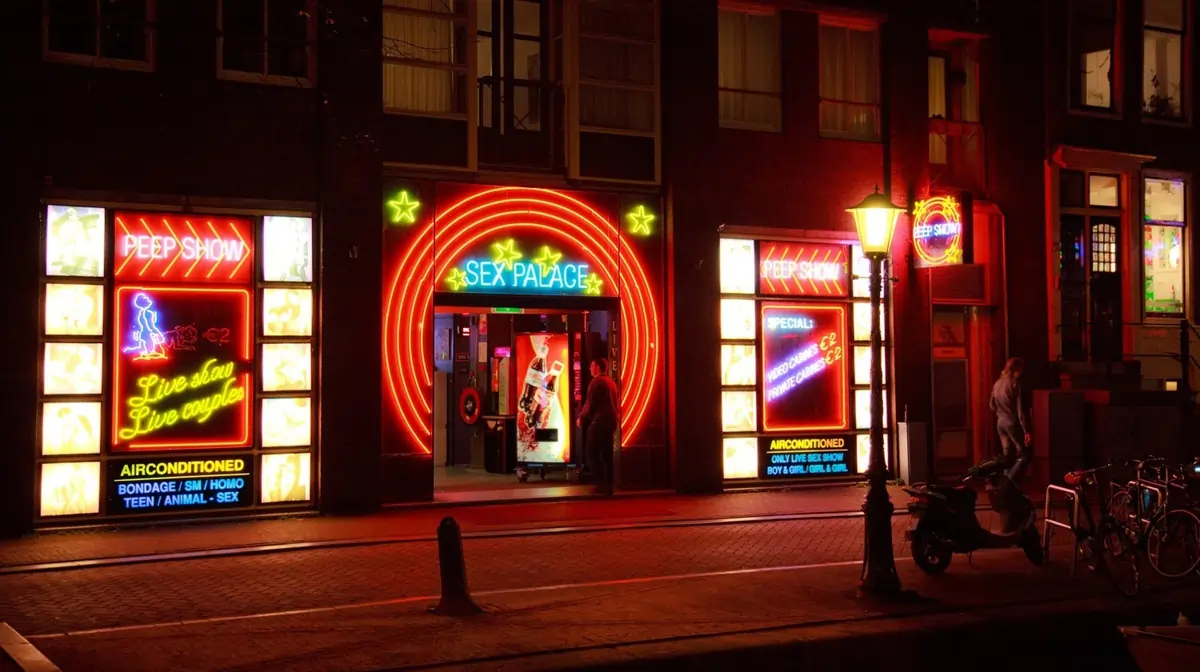
Erotic theatres and adult shows coexist with more mainstream nightlife.
- Casa Rosso on Oudezijds Achterburgwal 106–108 offers regulated stage performances.
- The Bananenbar presents playful, interactive shows with drinks included.
- Beyond the adult venues, nearby Rembrandtplein and Leidseplein host bars, clubs, and live music venues that stay open late into the night.
Tour Restrictions and Urban Policy
Amsterdam has long struggled with overtourism in De Wallen, prompting formal restrictions on guided tours.
In 2012, the city officially banned guided tours of more than four people from entering the Red Light District. This was not a recommendation or soft discouragement, but an enforceable restriction aimed at reducing crowding, voyeurism, and disruption to residents and sex workers.
Further measures followed in April 2020, when Amsterdam introduced a city-wide ban on commercial tours stopping directly in front of active sex work windows, alongside tighter controls on group movement through residential streets.
Together, these rules form part of Project 1012, a long-term urban policy initiative designed to reduce nuisance, protect workers’ dignity, and preserve the district’s historic character while maintaining lawful activity.
The Future of De Wallen
City authorities continue debating an “Erotic Centre” outside the historic core to decentralise sex work.
Supporters believe relocation would reduce crowding and improve safety; critics fear it could marginalise workers and erode heritage value.
Meanwhile, adaptive reuse of closed windows into galleries, cafés, and start-ups reflects a broader effort to diversify the district’s economy.
The future of De Wallen will likely balance worker protection, cultural preservation, and tourism management, a uniquely Dutch compromise between realism and reform.
Ethical Tourism and Public Perception
Visiting De Wallen responsibly means recognising sex work as regulated labour, not voyeuristic entertainment.
By approaching the area with empathy and informed curiosity, travellers help sustain Amsterdam’s model of openness grounded in human dignity.
Frequently Asked Questions
Is prostitution legal in Amsterdam?
Yes. Since 1 October 2000, brothels have been legal and regulated.
Can I take photos?
No. Photographing sex workers or their windows violates local ordinances and privacy rules; it is strongly enforced.
When did tour restrictions begin?
Initial limits appeared around 2012, with stricter bans, such as no stops at windows, coming into effect in April 2020.
Is De Wallen safe?
Yes. The district is heavily monitored and well-lit, but standard urban awareness applies.
When is the best time to visit?
Early evening (7–9 pm) offers the best blend of atmosphere and safety.
Conclusion: A Living Symbol of Tolerance
From its 13th-century origins beside a wooden chapel to its 21st-century regulation, De Wallen remains a mirror of Amsterdam’s enduring principle: freedom managed through responsibility.
Its cobblestones carry the imprint of sailors, saints, artists, and entrepreneurs, proof that moral complexity need not be hidden to be humane.
Visiting with respect ensures that the Red Light District continues to evolve as a place of heritage, honesty, and coexistence rather than solely as a site of controversy.
Beyond the Red Light District: Top Nightlife Spots Around Rembrandtplein
After exploring the historic lanes of De Wallen, the energy of Amsterdam doesn’t stop.
Just a short walk or tram ride away lies Rembrandtplein, one of the city’s most vibrant nightlife squares and a favourite gathering spot for both locals and visitors.
Top Nightlife Spots Around Rembrandtplein come alive after dark. From open-air terraces perfect for evening drinks to high-energy nightclubs that pulse until sunrise, the square offers something for every kind of night out.
Here you’ll find a mix of classic Dutch pubs, modern cocktail lounges, live-music venues, and restaurants that stay open late, creating a lively continuation of the Red Light District experience in a more open, festive setting.
Whether you’re looking to unwind with friends, enjoy live DJ sets, or simply people-watch beneath the glow of Rembrandt’s statue, Rembrandtplein captures the spirit of Amsterdam’s diverse, welcoming, and always in motion nightlife.