The High German and Portuguese synagogues are presented as window 19 of the Canon of Amsterdam.
This window reflects Amsterdam’s position as a place where Jewish communities established durable religious institutions at a time when such stability was rare in Europe.
Within the Canon, the date associated with this window is 1671, marking the completion of the Great Ashkenazi Synagogue.
This date precedes the completion of the Portuguese Synagogue in 1675 and reflects the broader institutional consolidation of Jewish religious life in the city rather than a single building event.
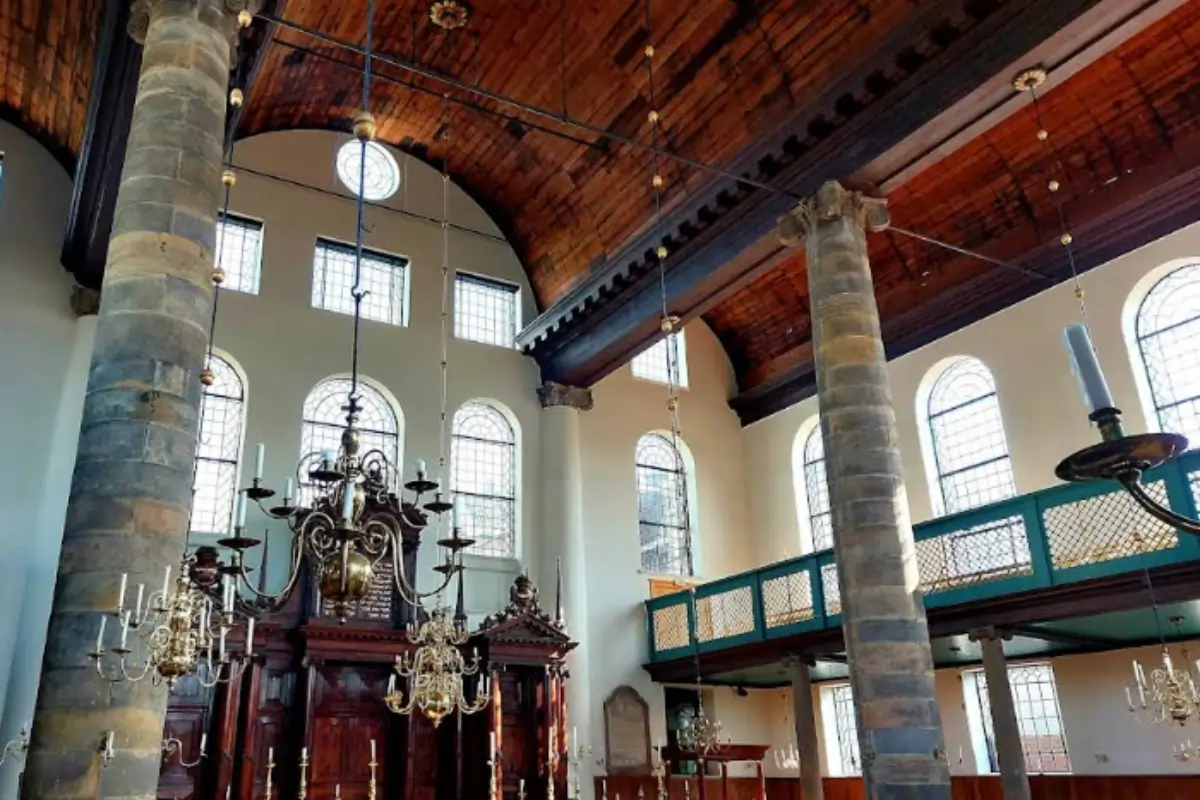
Table of Contents
Amsterdam’s Approach to Jewish Settlement
From the late sixteenth century onward, Amsterdam adopted policies that allowed Jewish residents a degree of security and autonomy uncommon elsewhere.
Jews were permitted to settle throughout the city, practise Judaism openly, and establish synagogues without being confined to compulsory districts.
This approach was pragmatic rather than ideological. Jewish merchants, financiers, printers, and traders contributed to the city’s economic growth, and municipal authorities largely prioritised order and productivity over religious uniformity.
Amsterdam did not impose ghettos. Jewish families lived across different neighbourhoods, and there is little evidence of systematic residential segregation during this period.
Sephardic Migration from Spain and Portugal
The earliest Jewish settlers in Amsterdam were Sephardic Jews who arrived at the end of the sixteenth century from Spain and Portugal.
In those regions, the Inquisition criminalised Jewish religious practice. Jews were forced to convert to Christianity, and those who continued to practise Judaism faced execution.
Amsterdam provided a setting in which these migrants could resume open religious life. Many Sephardic families possessed commercial networks, education, and capital.
They became active in international trade, finance, publishing, and scholarship, forming one of the most economically secure Jewish communities in Europe.
Their stability enabled the construction of major communal buildings and institutions, including a large synagogue intended to serve both religious and symbolic functions.
The Portuguese Synagogue at Mr. Visserplein
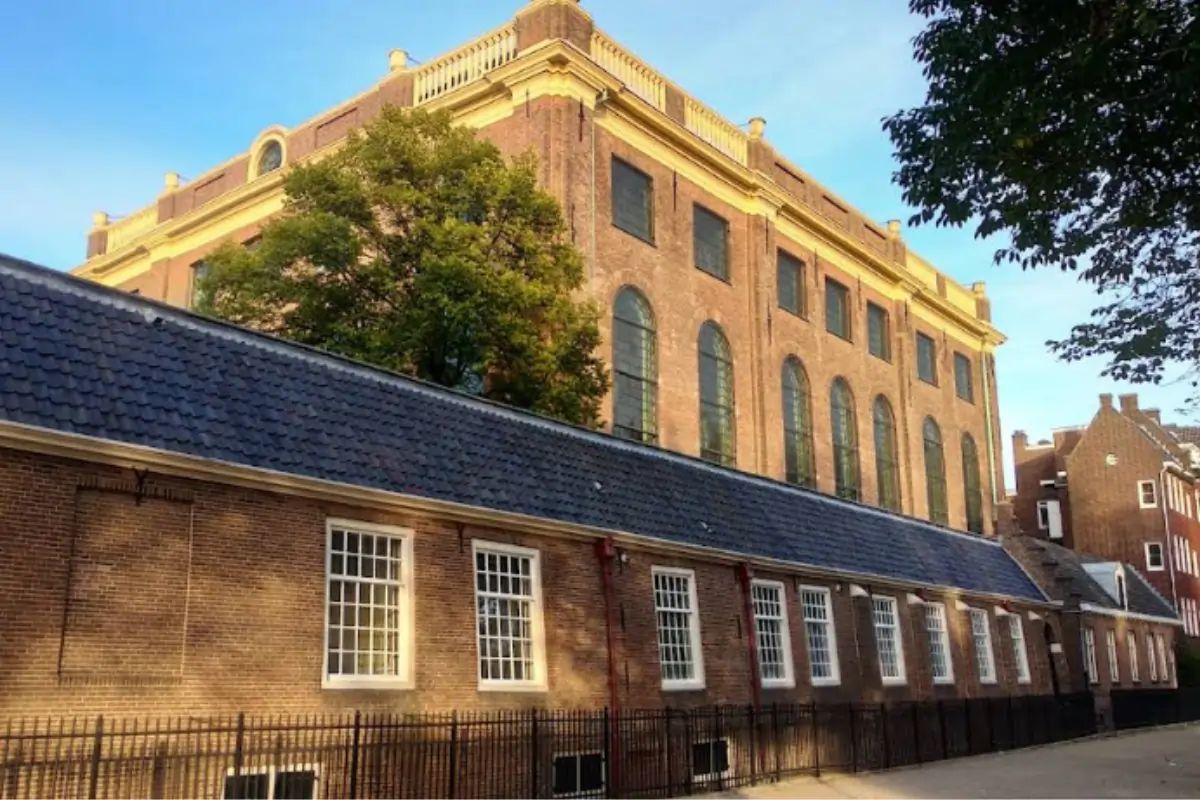
Completed in 1675, the Portuguese Synagogue stands at Mr. Visserplein. It remains one of the largest surviving seventeenth-century synagogues in Europe.
The building was designed to accommodate large congregations and reflects the organisational strength of the Sephardic community.
Its interior arrangement follows Iberian Jewish tradition, with a central reading platform and extensive use of natural light. The synagogue continues to function as a place of worship today.
Beyond religious use, the Portuguese Synagogue served as a centre of learning and intellectual exchange.
Members of the Sephardic community were involved in printing, philosophy, and theological debate, reinforcing Amsterdam’s reputation as a centre of scholarship.
Arrival of High German (Ashkenazi) Jews
From the early seventeenth century, Jews from Germany and Central Europe began settling in Amsterdam. These High German, or Ashkenazi, Jews differed markedly from the Sephardic population.
Many arrived with minimal resources and limited formal education. Later waves came from Poland, Lithuania, and Ukraine while fleeing severe persecution.
These groups spoke Yiddish, a language that left a lasting imprint on everyday speech in Amsterdam.
Economic conditions among Ashkenazi Jews were often extremely difficult. By the late eighteenth century, the majority relied on communal poor relief.
This level of poverty stood in stark contrast to the relatively secure position of the Sephardic community and even to the city’s general population.
Ashkenazi Synagogues and Institutions
As the Ashkenazi population grew, separate synagogues were established to serve their religious needs.
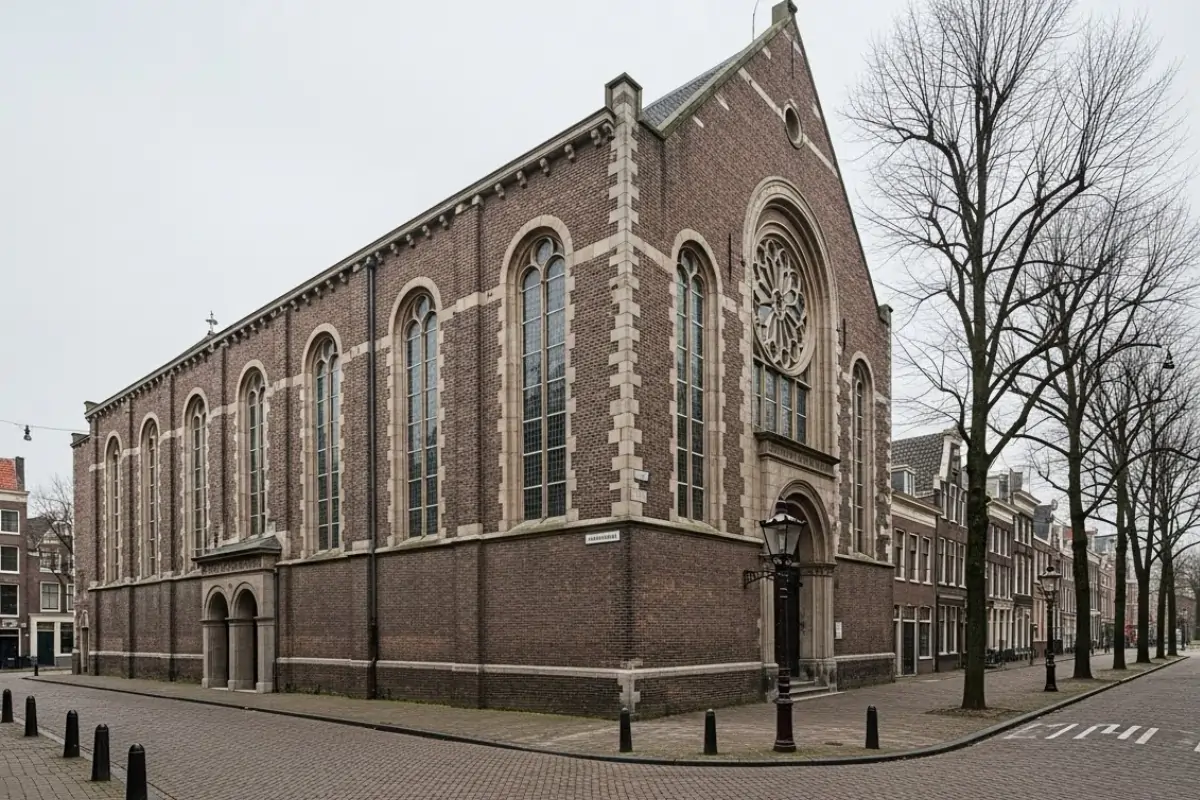
The Great Ashkenazi Synagogue, completed in 1671, became a central institution and forms the chronological basis for window 19 in the Canon.
Ashkenazi synagogues followed different liturgical practices and organisational structures from their Sephardic counterparts.
Alongside places of worship, the community developed extensive charitable networks, burial societies, and relief systems to support large numbers of impoverished members.
Despite economic hardship, Ashkenazi institutions became permanent elements of Amsterdam’s religious landscape.
Economic Activity and Guild Restrictions
Jewish residents in Amsterdam were active across a wide range of economic sectors.
They worked as market traders, peddlers, shopkeepers, financiers, diamond cutters, tobacco processors, silk workers, and sugar refiners.
Guild membership remained a critical barrier. Although Amsterdam’s guild system was more flexible than that in many other cities, it sometimes charged lower fees and allowed limited participation.
Jews were excluded from trades that required citizenship or formal guild admission.
This exclusion shaped Jewish economic specialisation. Diamond cutting, for example, was not governed by a guild, making it one of the few skilled crafts accessible to Jewish workers.
Social Boundaries and Legal Restrictions
While Jewish residents were generally tolerated, clear legal boundaries existed. Jews were forbidden from intimate relationships with Christians, including marriage and sexual contact with prostitutes.
These regulations were enforced as part of broader moral and religious codes.
Aside from these restrictions and guild exclusion, Jewish communities were largely permitted to regulate their own affairs.
Religious courts, welfare systems, and educational institutions operated with limited interference from municipal authorities.
Separate Communities Within One City
Sephardic and Ashkenazi Jews did not integrate closely. Differences in language, religious customs, economic position, and cultural background led to parallel community development.
Each group maintained its own synagogues, leadership structures, and charitable systems.
This separation was structural rather than conflict-driven and remained a defining feature of Jewish life in Amsterdam for centuries.
Canon of Amsterdam – Window 19
The High German and Portuguese synagogues are collectively represented as window 19 of the Canon of Amsterdam.
The Canon date of 1671 reflects the establishment of enduring Ashkenazi institutions, while the Portuguese Synagogue, completed in 1675, illustrates Sephardic consolidation.
Together, these buildings document how Jewish communities established religious continuity in a city that offered legal stability and relative protection during a period marked elsewhere by exclusion and violence.
FAQs
Q. What is window 19 of the Canon of Amsterdam?
It covers the establishment of Jewish religious institutions, centred on the High German and Portuguese synagogues.
Q. Why is the Canon date 1671?
It marks the completion of the Great Ashkenazi Synagogue, not the Portuguese Synagogue.
Q. When was the Portuguese Synagogue built?
The Portuguese Synagogue was completed in 1675.
Q. Did Amsterdam force Jews into ghettos?
No, Jews were allowed to live throughout the city.
Q. Were Jews allowed to work freely?
They could work in many trades but were restricted from guild-protected professions.
Q. Why were Ashkenazi Jews poorer than Sephardic Jews?
Most arrived as refugees with limited resources and relied heavily on communal support.
Q. Did Sephardic and Ashkenazi Jews worship together?
No, they maintained separate synagogues and religious customs.
Q. Why are these synagogues historically important?
They show how Jewish religious life achieved long-term stability in Amsterdam
From Early Settlement to Twentieth-Century Persecution
The relative security that Jewish communities experienced in Amsterdam during the seventeenth century did not continue uninterrupted into the modern era.
While the High German and Portuguese synagogues reflect a period of institutional stability, Jewish life in the city would later face systematic destruction during the Second World War.
By the twentieth century, Amsterdam was home to one of the largest Jewish populations in Western Europe.
That long-established presence made the impact of Nazi occupation particularly severe.
Deportations, exclusion from public life, and mass murder dismantled communities that had existed for centuries.
To understand how the early history of Jewish settlement contrasts with the events of the 1940s.
Read the detailed account of persecution, deportation, and survival during the German occupation in the Jewish Holocaust in Amsterdam.
This connection places the High German and Portuguese synagogues within the full historical arc of Jewish life in Amsterdam, from legal acceptance and community building to one of the darkest periods in the city’s history.