Table of Contents
What is the accordion, and why does it matter for visitors to Amsterdam?
The accordion is a free-reed musical instrument that forms part of Amsterdam’s recognised street and neighbourhood sound culture.
For visitors, understanding the accordion helps explain why certain historic districts, especially the Jordaan, are closely associated with live, informal music rather than scheduled concerts.
This overview is intended for travellers interested in cultural context, not performance instruction or music promotion.
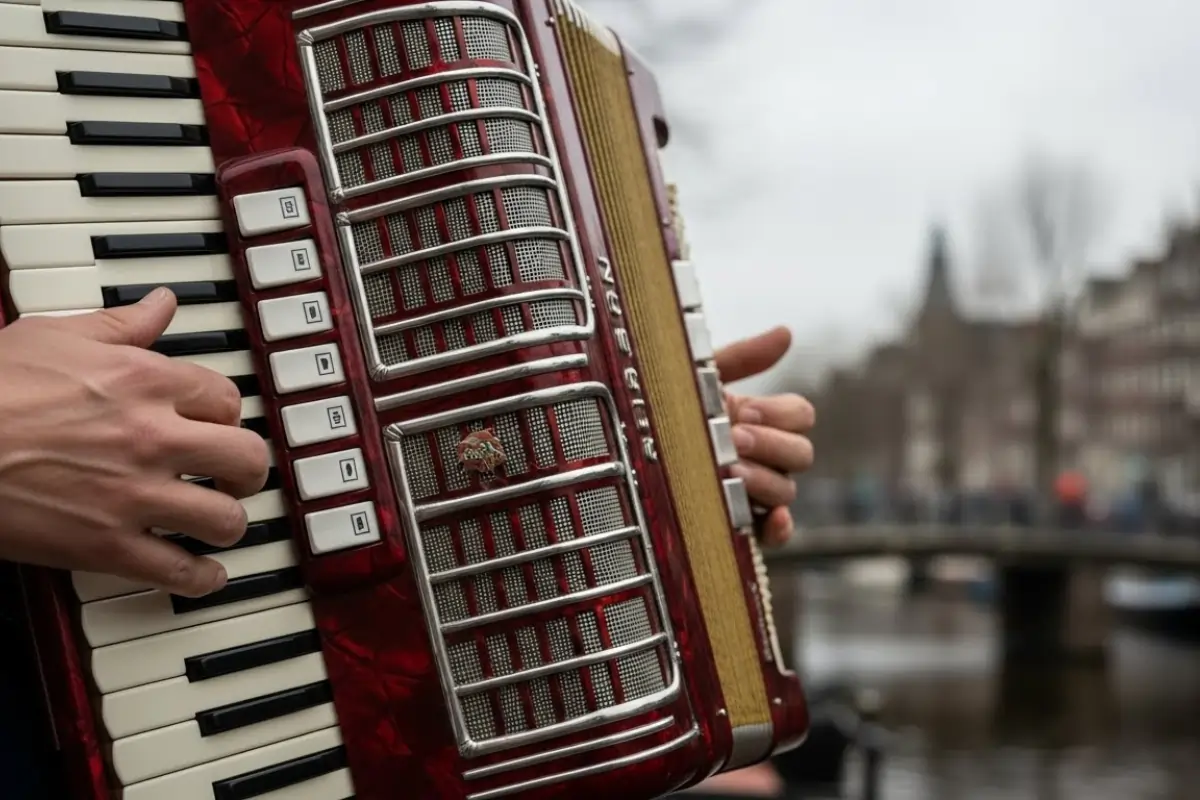
How does an accordion work?
An accordion produces sound when air is pushed through metal reeds by moving a bellows.
Pressing a key or button opens a valve that directs air across a specific reed, causing vibration and producing a fixed pitch.
Unlike string instruments, volume and expression are controlled by bellows pressure. This mechanical principle places the accordion in the same free-reed family as harmonicas and reed organs.
What types of accordions are used in Amsterdam?
Two accordion formats are commonly encountered in the Netherlands.
Both use the same internal mechanics but differ in keyboard layout.
The main types are:
- Piano accordion (klavieraccordeon), with a piano-style keyboard on the right-hand side.
- Button accordion (knopaccordeon), using multiple rows of buttons, typically three to five.
Button accordions are often linked to traditional Dutch and European folk styles, while piano accordions are more common in popular and jazz-oriented performance.

Why is the accordion associated with the Jordaan district?
The accordion became strongly associated with the Jordaan through its role in Jordaanlied and working-class neighbourhood culture.
The instrument was already in use in the area during the interwar period and became especially visible during the genre’s peak in popularity in the 1950s.
It is important to clarify that this association did not originate from large-scale Southern European migration in the 1950s.
Historical sources describe the Jordaan’s musical influences as mixed, shaped by local traditions, Jewish musical heritage, and ideas introduced by sailors and port workers who lived in the area.
When did accordion music become most visible in Amsterdam?
Accordion music reached its widest public recognition in the Jordaan during the 1950s.
This decade marked the height of Jordaanlied popularity rather than the beginning of accordion use in the city.
The instrument had already been established in neighbourhood music earlier in the 20th century, but post-war radio, recordings, and local performances increased its visibility.
Where might visitors hear accordion music today?
Accordion music in Amsterdam is most often encountered informally rather than in fixed venues.
It appears as part of everyday street life rather than scheduled cultural programming.
Common settings include:
- Pedestrian streets in historic districts such as the Jordaan
- Local cafés hosting live music
- Seasonal neighbourhood events and small festivals
Street performance is subject to municipal rules regarding location and duration, which are periodically updated by the city.

Is the accordion featured in museums or official attractions?
Amsterdam does not have a museum dedicated solely to the accordion.
However, the instrument appears in exhibitions focused on popular music, neighbourhood history, or post-war urban culture.
According to current venue guidance, references to accordion music typically appear in broader social history displays rather than in permanent collections.
FAQs
Q. Is accordion music traditional in Amsterdam?
Yes. The accordion has been part of Amsterdam’s local music culture since the early 20th century, particularly in working-class districts.
Q. Is accordion street music allowed in Amsterdam?
Yes, but it is regulated. Performers must follow city rules on location, timing, and sound levels.
Q. Do visitors need tickets to hear accordion music?
No. Most accordion performances encountered by visitors are informal and take place in public or café settings.
Q. Is the accordion linked to immigration history?
The instrument reflects mixed cultural influences. Its presence in the Jordaan predates large-scale Southern European labour migration, which began mainly in the 1960s.
Q. Can visitors photograph accordion performers?
Photography is generally permitted in public spaces if it does not interfere with performances or violate posted rules.
What should visitors take away from this guide?
This guide is intended for visitors seeking cultural background rather than scheduled attractions.
Understanding the accordion helps explain the sounds and musical references encountered while walking through older Amsterdam neighbourhoods.
For trip planning, the key takeaway is that accordion music is a situational experience heard while exploring the city rather than something booked or formally programmed.
How is accordion music different from Dutch barrel organs in Amsterdam?
Accordion music is performed live by a musician using a hand-operated bellows, while Dutch barrel organs are mechanical instruments that play pre-set music from pinned barrels.
Visitors typically encounter accordions in informal street or café settings, whereas barrel organs are larger, stationary instruments operated under specific municipal permissions.
Both instruments rely on airflow and reeds but serve different cultural roles. Dutch barrel organs were historically associated with licensed street performance and organised collections, whereas accordions became part of neighbourhood-based music traditions.
For readers interested in understanding Amsterdam’s mechanical street music tradition, a separate guide explains how Dutch barrel organs work, where they are permitted, and why they remain visible in certain public areas.