Table of Contents
How Did the Blaeu Family Become the Most Influential Cartographers of the Dutch Golden Age?
The Blaeu family shaped European understanding of geography throughout the seventeenth century.
Their atlases, globes and wall maps combined scientific precision with detailed visual design, and their Amsterdam workshop became a leading centre for print and map production.
Modern museums, universities and collectors continue to study and preserve their output, demonstrating the family’s lasting importance.
This article fills gaps left by competing guides by examining early influences, workshop development, VOC connections, production standards, major works and current collections.
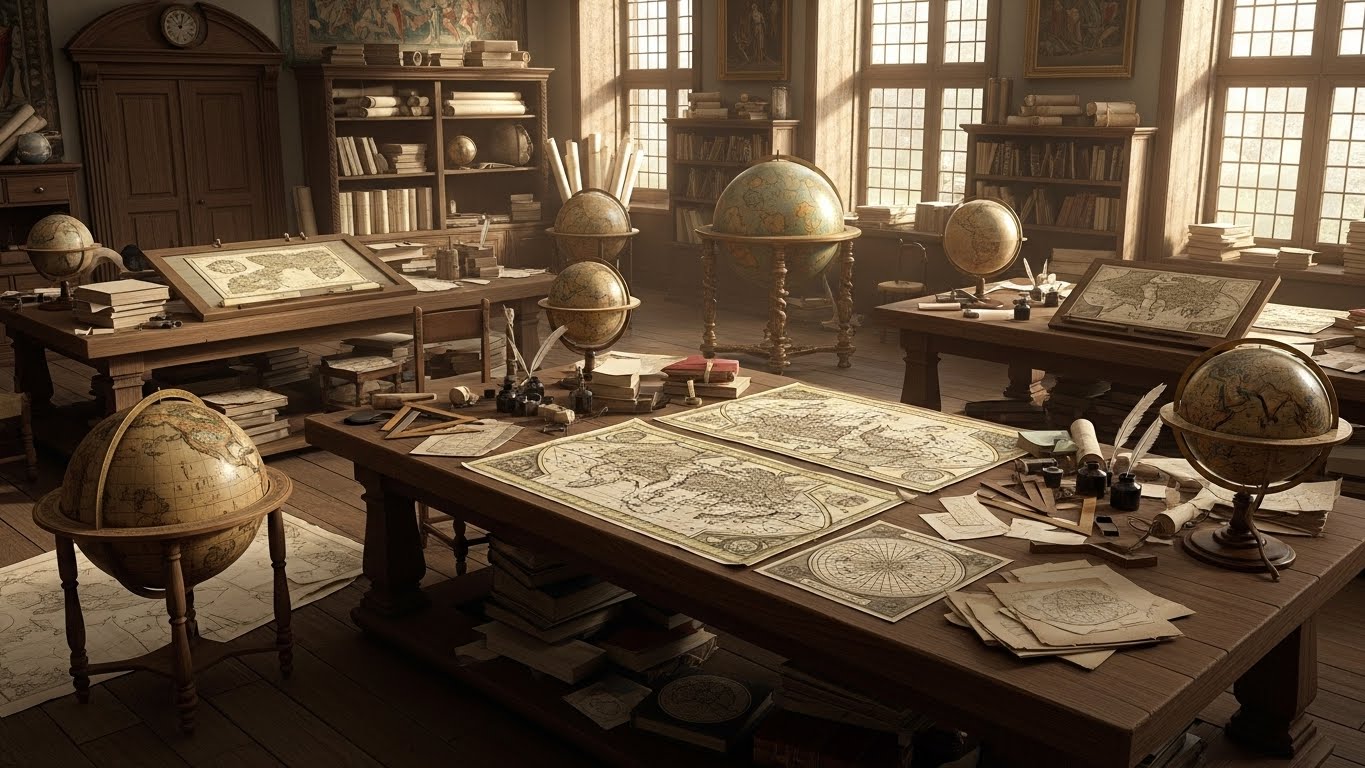
Why Did Amsterdam Become the Blaeu Family’s Base of Operations?
Amsterdam offered the ideal setting for a high-level cartographic firm.
Its international port, large printing industry and strong academic community created a reliable supply of the skills and materials required for complex publications.
Advantages included:
- Regional paper mills are capable of producing strong, smooth sheets.
- Skilled engravers experienced in copperplate work.
- Merchant and VOC reports that delivered new geographic information.
- A large customer base that included scholars, diplomats and collectors.
This environment enabled the Blaeu firm to create extensive multi-volume atlases and become a dominant force in early cartography.
Who Established the Blaeu Mapmaking Tradition?
The founder, Willem Janszoon Blaeu, was born in Uitgeest in 1571.
He trained under the astronomer Tycho Brahe on the island of Hven, learning instrument construction and observational techniques that formed the basis of his later craft.
Willem returned to the Netherlands in 1596 and initially settled in Alkmaar.
He moved to Amsterdam around 1598 or 1599. His first workshop operated in De Lastage, close to the shipyards and wharves, where he could gather information from sailors and traders.
Around 1605, Willem relocated to the Damrak, where he worked in the building known as De Vergulde Sonnewijser.
Only in 1637 did he move the workshop to the Bloemgracht in the Jordaan district.
Willem died in 1638, leaving behind a strong and expanding enterprise.

How Accurate Is the Information About Joan Blaeu’s Birth Year?
Most reputable sources list 1596 as the birth year of Joan Blaeu, although some scholarly references propose a date around 1598 or 1599.
The year 1596 remains the most widely accepted, especially in museum and academic catalogues.
Joan became the intellectual leader of the family firm, building on his father’s foundations and guiding its most ambitious publications.
How Did Joan and Cornelis Blaeu Develop the Firm Further?
After Willem’s death, his sons Joan and Cornelis Blaeu carried the company forward.
They improved engraving quality, expanded editorial oversight and produced a greater range of atlases and charts.
Their contributions included:
- Comprehensive regional atlases covering Europe and parts of Asia, Africa and the Americas.
- Sea charts used by VOC navigators.
- Globes are displayed in courts, universities and scientific institutions.
- City books featuring detailed plans and architectural drawings.
Joan became the principal editor and oversaw the creation of the family’s most significant project, the Atlas Maior.
What Made the Atlas Maior Such a Landmark Publication?
The Atlas Maior, published between 1662 and 1672, was the largest and most ambitious atlas of its time.
It appeared in several languages and documented regions across the world with detailed maps and extensive descriptive text.
Its significance lies in:
- The large number of maps is printed across multiple volumes.
- High-quality copperplate engraving and consistent page layout.
- Carefully organised geographic and historical commentary.
- Decorative elements that enhanced readability and artistic appeal.
The Atlas Maior remains highly regarded among historians and collectors, and complete sets often command substantial prices at major auctions.

How Did the Dutch East India Company Shape Blaeu Cartography?
The Blaeu firm benefited significantly from its relationship with the VOC, which relied on accurate charts for navigation.
Captains and pilots were required to deliver logs, sketches, depth soundings and updated coastal outlines upon returning from voyages.
This partnership influenced Blaeu cartography in several ways:
- Sea charts gained improved detail and reliability.
- Regional maps of Asia, Africa and Brazil became more accurate than earlier European versions.
- Confidential VOC materials helped refine the firm’s unpublished drafts and future editions.
The close alignment of the VOC with the Blaeu workshop strengthened Dutch trading power and helped the company surpass its European rivals.
How Did the Blaeu Workshop Maintain High Production Standards?
The workshop achieved its reputation through careful craftsmanship and strict quality control.
Key methods included:
- Copperplate engraving for sharp lines and intricate ornamentation.
- Layered hand-colouring performed by trained colourists.
- Standardised typefaces for clarity across long texts.
- Proofing procedures designed to catch mapping inconsistencies.
- Decorative cartouches, ships and landscapes that added context and visual interest.
These techniques allowed Blaeu’s works to retain their clarity and aesthetic appeal for centuries.
Where Are the Most Important Blaeu Collections Located Today?
Blaeu materials are preserved worldwide. Significant collections appear in:
- Library of Congress, with a detailed guide to Blaeu works.
- Het Scheepvaartmuseum in Amsterdam, featuring the exhibition The World According to Blaeu.
- Antiquemaps.com, offering catalogues and historical notes.
- Antique Print Map Room, documenting editions and collector insights.
- VU University Amsterdam Library, which holds several atlases.
- Marburg University Library in Germany has early copies.
- Tresoar in Leeuwarden, which maintains regional maps.
- Canon of Amsterdam, where the family is featured in window 18.
These collections support academic research and allow comparison of printing states, colour variations and engraving updates.
Why Do Collectors Continue to Seek Blaeu Atlases?
Blaeu atlases remain popular among collectors because they offer:
- Strong historical relevance to early exploration and navigation.
- High artistic quality in both engraving and colour application.
- Clear explanations of geography, regional features and city plans.
- Durable materials and well-organised layouts.
- A significant role in shaping early world atlases.
Auction prices vary based on completeness, condition, edition, colour and provenance. Major sets continue to attract considerable interest.
What Impact Did the Blaeu Family Leave on the History of Cartography?
The Blaeu family influenced the long-term development of mapping in several ways:
- They helped set standards for atlas structure and organisation.
- Their work shaped the visual style of European mapmaking.
- Their sea charts supported navigation across multiple continents.
- Their atlases influenced state cartographic offices and libraries.
- Their maps served as reference tools for scholars, merchants and diplomats.
This legacy remains visible in museum displays, academic studies and specialist collections.
FAQ
Q. What is considered the most important work produced by the Blaeu family?
The Atlas Maior is widely regarded as their most significant and influential publication.
Q. How did Willem receive his early training?
He studied instrument making under Tycho Brahe, gaining experience with astronomical tools and measurement techniques.
Q. Why did Willem move his workshop more than once?
As demand grew, he relocated from De Lastage to the Damrak for greater visibility and larger facilities, then moved to Bloemgracht in 1637.
Q. How accurate are Blaeu maps by modern standards?
While not modern in precision, they were among the most accurate of their era and remain valuable for historical research.
Q. Which institutions hold the largest number of Blaeu works?
Major holdings are at the Library of Congress, Het Scheepvaartmuseum, Tresoar and large university libraries across Europe.
Q. Are Blaeu globes rarer than their atlases?
Yes. Fewer globes survive, making original pairs especially desirable among museums and collectors.
Q. Are digital versions of Blaeu atlases available?
Yes. Many libraries, including national and university institutions, provide online access to scanned editions.
How Does Dutch Artistic Heritage Connect to the Work of Joan Blaeu?
The Netherlands has produced several figures whose work shaped global culture.
Joan Blaeu influenced geographic understanding with detailed atlases, while later artists such as Vincent van Gogh transformed how landscapes and colour were interpreted in art.
Both contributed to the international reputation of Dutch creativity, although they worked in different centuries and fields.