Table of Contents
What Is Felix Meritis?
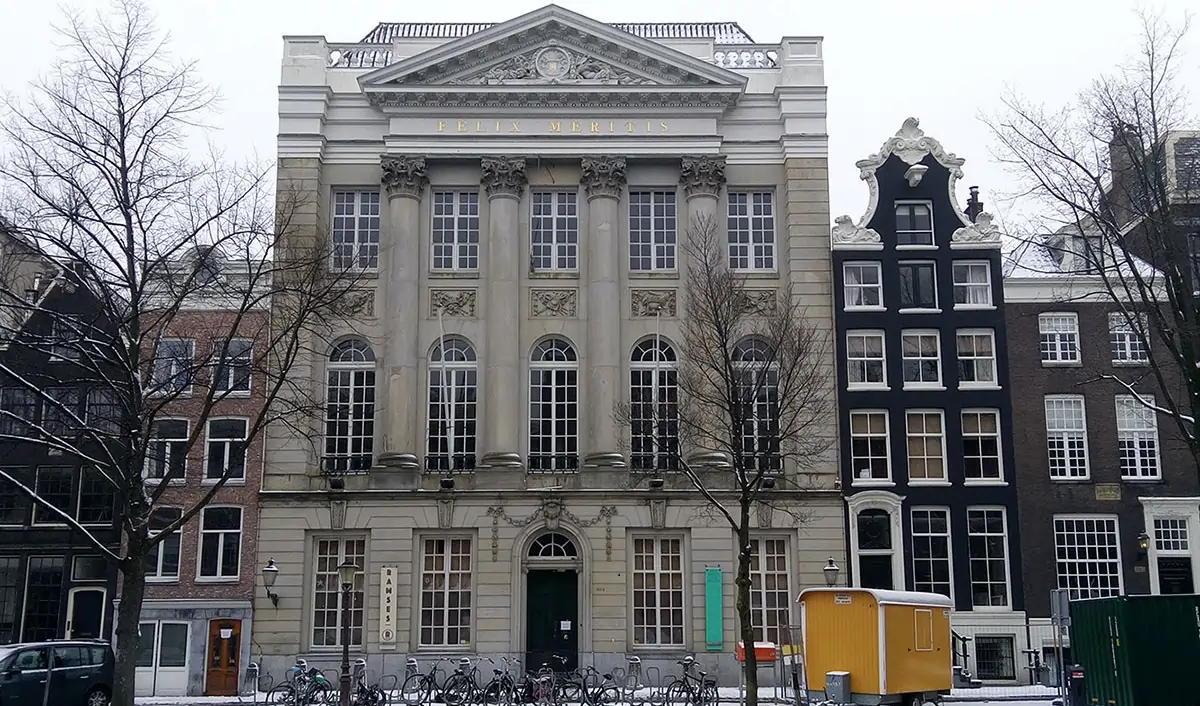
Felix Meritis is a landmark building on Keizersgracht 324 that originally served as the headquarters of a society founded in 1777 to promote cultural and scientific advancement.
The society focused on music, literature, drawing, physics and commerce, bringing together some of the most influential thinkers and creators in Amsterdam.
Today, the building operates as a modern cultural centre that hosts concerts, exhibitions, debates, conferences and public events.
Why Was the Felix Meritis Society Created?
During the late eighteenth century, Amsterdam saw a strong rise in interest in science, philosophy and artistic expression.
A group of citizens sought to create a structured environment where the arts and sciences could thrive together.
Their goal was to encourage informed discussion, new artistic work and shared learning.
Membership was selective. Individuals needed to demonstrate established skills or achievements in one of the five core disciplines.
This led to a community that influenced cultural and intellectual life throughout the Netherlands.
Who Designed the Building and When Was It Constructed?
The society commissioned architect Jacob Otten Husly to design a building that reflected the cultural ideals of the period.
Construction began in 1787 and finished in 1788. Husly used a classical architectural language that highlighted balance, clarity and decorative detail.
The front of the building features symbols representing the society’s five departments. A beehive at the top symbolises cooperation and collective progress.

What Were the Original Features Inside Felix Meritis?
Felix Meritis contained a range of specialised rooms that reflected the interests of its members. Key features included:
- A celebrated oval concert hall known for excellent sound qualities.
- A drawing room and meeting spaces for lectures and presentations.
- A library.
- An observatory located above the central structure, one of the earliest in the Netherlands.
These facilities made the building a prominent location for knowledge exchange and artistic performance.
What Happened After the Original Society Dissolved?
The society ended its activities in 1888. The building then went through several new chapters:
- It served as a printing works during the late nineteenth century.
- It became the headquarters of the Communist Party of the Netherlands during the mid-twentieth century.
- From the 1960s onward, part of the building was transformed into the Shaffyzaal, a theatre hall named after performer Ramses Shaffy. This hall became a popular meeting place for young creators, musicians and actors.
Each period left its own imprint on the building’s identity.
How Was Felix Meritis Restored in the Twenty-First Century?
In 2014, the building entered a major restoration project supported by Amerborgh.
MATH architecten worked on the architectural renovation, and interior studio i29 redesigned the internal spaces.
The aim was to preserve historic elements while creating rooms suitable for modern cultural programming. Updates included:
- Careful restoration of original ceilings, decorative work and staircases.
- Structural improvements.
- Installation of current technical systems.
- Introduction of new lighting and interior features that complement the classical style.
The renovated building reopened to the public with upgraded halls and improved comfort.

What Can Visitors Expect at Felix Meritis Today?
Visitors can experience cultural programming throughout the year. Activities include:
- Concerts
- Public debates
- Film screenings
- Lectures on science, society and culture
- Exhibitions
- Festivals
- Workshops
- Private events and conferences
A restaurant and reception area provide additional comfort for guests.
Guided tours are offered on select dates, allowing visitors to explore the design, artwork and history of the building.
Where Is Felix Meritis Located?
Felix Meritis stands on Keizersgracht, part of the Amsterdam canal ring area.
This area has UNESCO World Heritage status and is known for its elegant canal houses, museums and historical sites.
The central location makes it easy to reach from other well-known locations such as the Anne Frank House, Leidseplein and the Nine Streets.

Timeline of Felix Meritis
1777
Founding of the Felix Meritis Society.
1787–1788
Construction of the building designed by Jacob Otten Husly.
1788–1888
Active use by society for cultural and scientific activities.
Late 1800s
Conversion into a printing works.
1947–1981
Used by the Communist Party of the Netherlands and its newspaper.
1960s–1980s
Shaffyzaal theatre hall emerges as a creative hotspot.
1988
Reopening as a cultural centre.
2014–2020
Extensive restoration and redesign by MATH architecten and i29.
2020–present
Modern cultural programming continues on a wide scale.
Key Entities Connected to Felix Meritis
- Jacob Otten Husly (architect)
- Felix Meritis Society (founding organisation)
- Ramses Shaffy (performer connected to Shaffyzaal)
- MATH architecten (restoration architects)
- i29 interior architects (interior redesign)
- Amerborgh (investment and restoration support)
- Keizersgracht 324 (address)
- Amsterdam Canal Belt (UNESCO area)
FAQ About Felix Meritis
Q. What is Felix Meritis used for today?
It operates as a cultural centre that hosts concerts, debates, exhibitions, festivals and private events.
Q. Can you visit the inside of the building?
Yes. Visitors attending events can enter the building, and guided tours are available on selected dates.
Q. What makes the architecture special?
The building is an important example of late eighteenth-century classical design. It includes an oval concert hall, detailed facade symbols, historic staircases and one of the oldest observatories in the Netherlands.
Q. Is Felix Meritis near other major attractions?
Yes. It is located along the Keizersgracht canal and is close to the Anne Frank House, Westerkerk, the Nine Streets and Leidseplein.
Q. Does the building still serve the same purpose as in the past?
Although the membership society no longer exists, the building continues to support cultural and academic activity, similar to its original intentions.
Q. Is Felix Meritis part of the Canon of Amsterdam?
Yes. Felix Meritis is listed as Window 23 on the Canon of Amsterdam.
What Other Nearby Historic Sites Can You Visit After Felix Meritis?
Felix Meritis sits in the heart of the canal district, and several important landmarks are only a short walk away.
Two of the most visited locations near Keizersgracht are the Westerkerk and the Anne Frank House.
Both offer visitors a deeper look into Amsterdam’s cultural and historical background.