Westerkerk stands as one of the most recognised structures in Amsterdam.
Built in the early 1600s, it became a centrepiece of the city’s Protestant identity and a point of civic pride during a period of rapid expansion.
Its tower, carillon, cultural associations and architectural presence make it one of the most significant religious sites in the country.
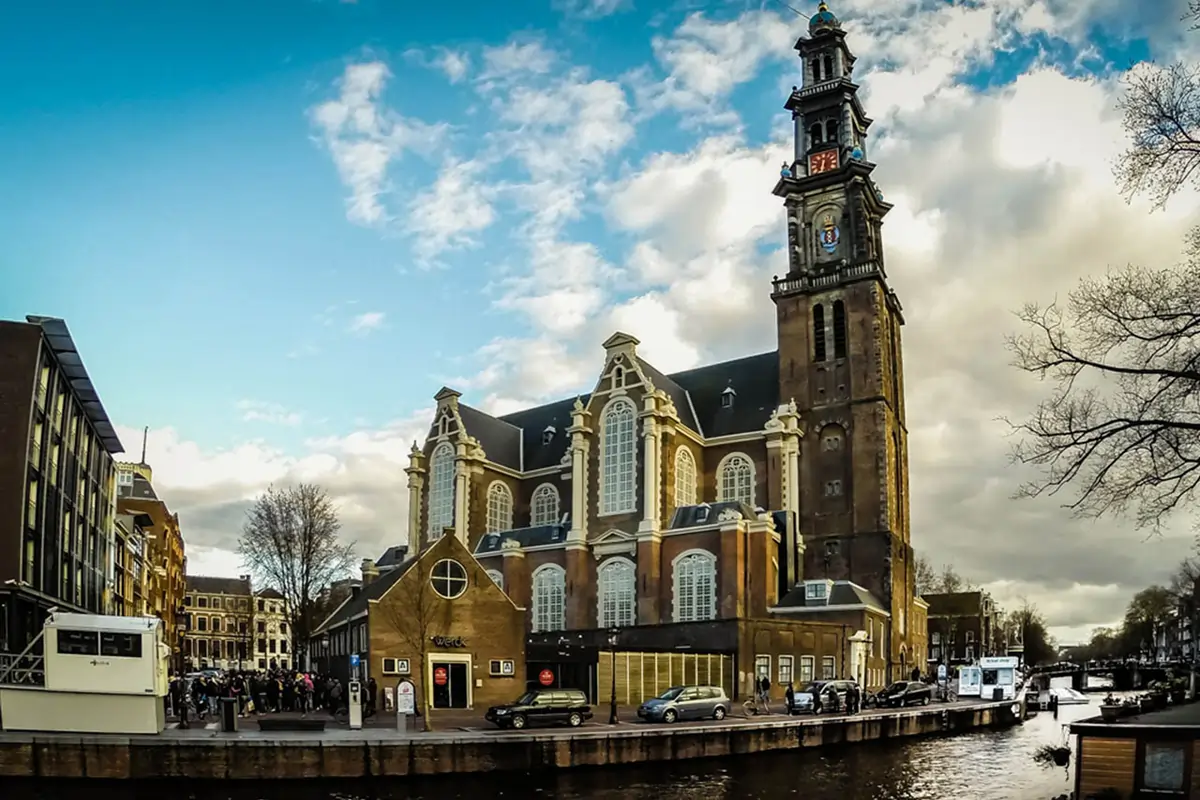
Table of Contents
Why Was Westerkerk Built in the First Place?
At the beginning of the 17th century, Amsterdam was growing quickly and needed new churches for its rising Protestant population.
The government wanted a building that matched the confidence of the expanding city while reflecting the modest character of Reformed worship.
This led to the construction of Westerkerk, started in 1620 and completed in 1631.
The church served two roles:
- It met the practical need for a large worship space for residents of the western districts.
- It acted as a civic statement during a time when the city was shaping its new religious orientation.
Its creation coincided with other major developments in the western canal ring, making it part of a broader urban plan.
Who Designed Westerkerk and What Influenced Its Appearance?
The original design came from Hendrick de Keyser, one of the most respected architects of the Dutch Renaissance.
After his death, his son Pieter de Keyser completed the project.
Westerkerk reflects the architectural ideas of the period:
- a tall layout with classical proportions
- decorative elements inspired by Renaissance forms
- large windows that bring natural light into the interior
- clear lines and balanced structure suitable for Protestant worship
The church has a double-cross ground plan, also known as a patriarchal cross.
This layout was unusual in the Netherlands at the time and contributed to the building’s distinct appearance.

Why Is the Westertoren Considered a Symbol of Amsterdam?
The tower beside the church is one of the tallest historic structures in Amsterdam, standing 85 meters high. Its height and design make it visible across much of the canal ring.
Its height and design make it visible from many points across the canal ring.
Key points that strengthen its cultural value:
- The top carries a replica of the Imperial Crown associated with Emperor Maximilian.
- The carillon contains more than 50 bells.
- The largest bell weighs more than 7500 kilograms and has been part of Amsterdam’s soundscape for centuries.
- The chimes follow a schedule that has helped residents keep time for generations.
Because of its visibility, sound and symbolic elements, the tower has become one of the most familiar sights in the historic centre.

How Is Westerkerk Connected to Important Lives and Events?
Several notable connections give the church deep historical weight:
Rembrandt
The famous painter died in 1669 in relative poverty.
He was buried in Westerkerk in an unmarked grave, like many citizens of limited means.
A plaque inside the church commemorates him today.
Royal Ceremony
Queen Beatrix married Prince Claus in the church in 1966.
This event was broadcast in multiple countries and confirmed Westerkerk’s status as a national monument.
Anne Frank
During her time in hiding, Anne Frank wrote that she could hear the bells of the tower from the Secret Annex.
This personal reference binds the church to one of the most widely read testimonies of the Second World War.
Cultural Tradition
For residents of Amsterdam, especially those from the Jordaan area, the church appears in local songs, stories and music traditions.
It plays a role in community identity and in artistic expression across generations.
What Can Visitors Expect Inside Westerkerk?
The interior expresses principles of Protestant simplicity while maintaining a refined architectural character.
Visitors will notice:
- a high nave supported by clean, classical columns
- large windows that brighten the space
- grey and white stucco with minimal ornamentation
- a well-known organ that hosts concerts throughout the year
- memorial tablets dedicated to past residents, musicians and local figures
The church is still active with services, events and music programmes, making it both a historical monument and a living institution.

What Should Visitors Know Before Arriving?
Westerkerk is located beside the Prinsengracht canal, near the border of the Jordaan district and close to other major attractions.
It remains one of the easiest churches to reach in the city centre.
Practical details for tourists include:
- The church is typically open on weekdays and Saturdays.
- Entry is usually free, with a voluntary contribution.
- The interior and tower may have separate access conditions depending on ongoing maintenance.
- Music events occur throughout the year, especially organ performances.
- Guided talks and informational sessions are sometimes available.
The surroundings offer views of canals, houseboats, historic streets and nearby cultural sites.
How Does Westerkerk Compare to Other Historic Churches in Amsterdam?
Amsterdam contains several 17th-century Protestant churches, including the Noorderkerk and Zuiderkerk.
Each served local neighbourhoods and reflected the city’s growth. However, Westerkerk stands apart due to:
- Its size is one of the largest churches built specifically for Protestant worship
- Its tall tower, which remains a citywide symbol
- Its connection to Rembrandt, Anne Frank and the Dutch Royal Family
- It’s a unique double-cross plan
- Its location beside one of the major canals of the western ring
- It’s an active music programme
- Its influential presence in Amsterdam’s cultural memory
These combined elements give Westerkerk a deeper level of historical and emotional significance compared to many other churches.
Why Does Westerkerk Still Matter Today?
Westerkerk remains relevant for several reasons:
- It provides insight into the city’s religious and architectural transformation in the 17th century.
- It demonstrates how civic and cultural influences shaped public buildings.
- It acts as a geographic reference point for both locals and visitors.
- It represents continuity, surviving changes in society, politics and urban life.
- It holds meaning for visitors interested in Rembrandt, Anne Frank, Dutch music traditions and royal history.
Its ongoing use for concerts, ceremonies and worship further strengthens its place in modern Amsterdam.
Final Thoughts
Westerkerk brings together architecture, community identity, historical memory and cultural expression.
Its tower shapes the skyline. Its interior reflects the principles of the era in which it was built.
Its associations with influential figures and events place it among the most important buildings in the Netherlands.
With its location alongside one of the most beautiful canals in Amsterdam.
It continues to attract visitors from around the world who want to learn about the city’s past and experience one of its most significant historic landmarks.
Looking for More Details About the Tower?
Visitors who want to learn more about the tower’s history, its crown, its bells and its view over the canal ring can read our dedicated page on the Westertoren (Wester Tower).
It explains the background of the design, the story behind the crown at the top and the features that make the tower one of the most recognised structures in Amsterdam.