Table of Contents
What is the Amsterdam Pole and why does it matter to visitors?
The Amsterdam Pole, commonly known as the Amsterdammertje, is a fixed street bollard used to separate pedestrian areas from traffic in Amsterdam.
For visitors, it is a practical part of the streetscape that influences how pavements, crossings, and cycling areas are laid out, especially in older neighbourhoods.
The pole is not a decorative object but a functional element that reflects how the city has managed traffic safety and public space for more than a century.
When were Amsterdammertjes first introduced?
Amsterdammertjes were introduced in the early twentieth century as part of Amsterdam’s formal street regulation system.
The first standardised cast-iron version was adopted in 1915, providing a consistent method of protecting pavements from carts and early motor traffic.
A subsequent design update addressed urban requirements, and a modern steel version entered widespread use in 1972, replacing cast iron in new installations.
What does “The Amsterdam Pole 1,000,000 times” refer to?
“The Amsterdam Pole 1,000,000 times” refers to the cumulative production of one million Amsterdammertjes rather than the number installed within Amsterdam itself.
By that stage, the bollard design had been adopted by multiple Dutch municipalities for similar traffic-control purposes.
The one-millionth Amsterdammertje was produced on 27 August 2006, marking the manufacturing milestone.
When was the millionth Amsterdammertje officially presented?
Although produced in 2006, the one-millionth Amsterdammertje was formally presented on 1 October 2010 during a ceremonial handover to the City of Amsterdam.
The presentation involved municipal representatives from the production region rather than Amsterdam-based manufacturing.
This distinction between production date and presentation date is a frequent point of confusion in published references.
Where were Amsterdammertjes manufactured?
Despite their close association with Amsterdam, Amsterdammertjes were not manufactured within the city.
Production took place in Zelhem, in the eastern Netherlands near the German border, within the municipality of Bronckhorst.
This manufacturing arrangement explains why visually identical poles later appeared in other Dutch towns, sometimes adapted with different emblems.

Why do Amsterdammertjes display three St Andrew’s crosses?
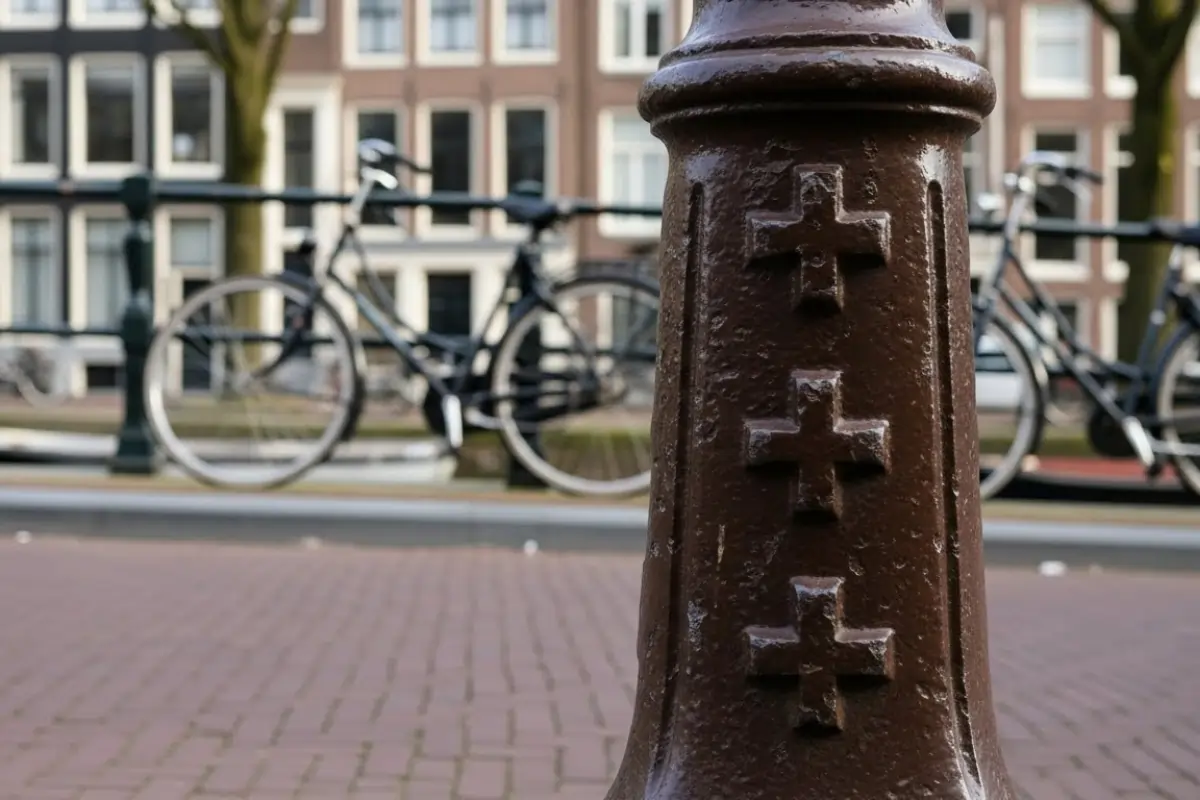
Many Amsterdammertjes feature three vertical St Andrew’s crosses, taken from Amsterdam’s official coat of arms.
These markings visually link the bollard to the city and make the design easily recognisable in historic streets.
When other municipalities adopted the same bollard design, the crosses were often replaced with local symbols to avoid implying Amsterdam authority.
Why were Amsterdammertjes removed from some streets?
Amsterdam has reduced the number of Amsterdammertjes gradually over several decades rather than through a single policy decision.
Removals began in the 1980s, particularly where raised pavements or alternative street layouts made individual bollards unnecessary.
During the 2000s, large-scale street redesigns increasingly relied on elevated kerbs and simplified surfaces, leading to further removals in areas prioritising accessibility and clearer pedestrian space.
Are Amsterdammertjes still visible in Amsterdam today?
Yes, Amsterdammertjes remain visible across Amsterdam, particularly in historic districts and residential streets developed before modern street design standards.
However, they are no longer installed uniformly throughout the city.
Visitors are most likely to encounter them in parts of Amsterdam-Centrum, along sections of the Canal Ring, and in older housing areas.

How do Amsterdammertjes affect walking and cycling?
The poles prevent cars from entering pavements while allowing pedestrians and cyclists to pass freely.
For visitors, this usually means safer walking conditions, though pavements may narrow at points where poles are closely spaced.
They also indicate boundaries between pedestrian areas and traffic zones, even where surface materials appear similar.
FAQs
Q. Are Amsterdammertjes unique to Amsterdam?
No. While designed for Amsterdam, the same bollard form was used in other Dutch municipalities, often with different symbols.
Q. Do all Amsterdammertjes show Amsterdam’s crosses?
No. Only those intended for Amsterdam display the three St Andrew’s crosses; versions used elsewhere typically feature local markings or none at all.
Q. Are Amsterdammertjes protected heritage objects?
Most are functional street furniture rather than protected monuments, although they contribute to the historic appearance of older streets.
Q. Why do some streets have none at all?
Streets redesigned with raised pavements or shared layouts often remove bollards entirely to simplify movement and maintenance.
Q. Can visitors photograph Amsterdammertjes?
Yes. They are public street objects and commonly photographed as part of Amsterdam’s urban environment.
Summary for Amsterdam visitors
This guide is intended for visitors who want to understand everyday features of Amsterdam’s streets rather than major attractions.
The Amsterdam Pole illustrates how traffic safety, street design, and local identity have evolved since 1915.
Recognising these bollards helps visitors read street layouts more clearly and move through the city with practical awareness.
Where can visitors most clearly see Amsterdammertjes in Amsterdam?
Visitors are most likely to encounter Amsterdammertjes in the oldest parts of the city, where historic street layouts still rely on traditional pavement separation.
These areas include sections of the Canal Ring and surrounding streets within Amsterdam’s old city centre, where bollards continue to mark boundaries between pedestrian space, cycling routes, and traffic.
For a broader understanding of how these streets developed and why older infrastructure elements remain in use, see the guide to the Amsterdam Old City Centre.
Which explains the layout, development history, and walking conditions visitors can expect in this part of the city.