Dutch barrel organs are large mechanical pipe organs designed for outdoor performance and commonly encountered in central Amsterdam streets and markets.
For visitors, they form part of the city’s everyday soundscape rather than a scheduled attraction.
This matters for trip planning because barrel organs appear irregularly, are subject to municipal street-music regulations, and are most often encountered while walking through historic districts rather than inside formal venues.
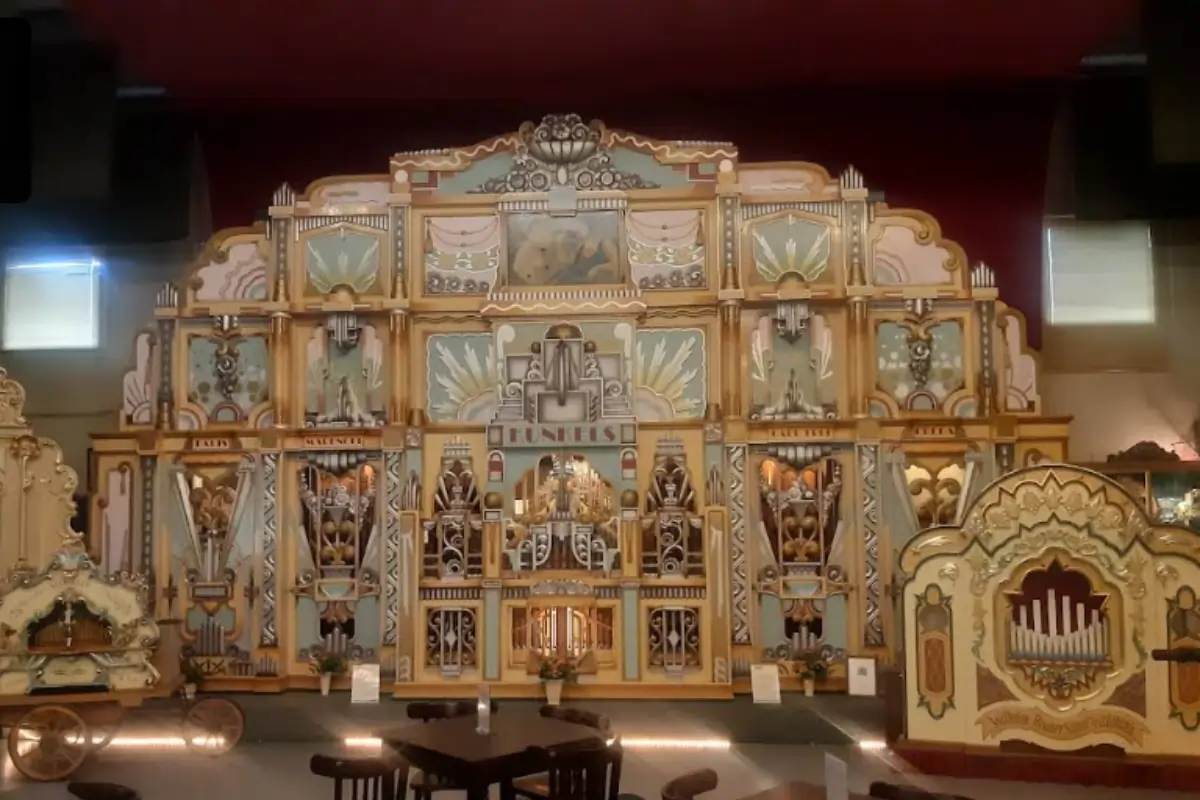
Table of Contents
How do barrel organs produce music?
Barrel organs generate sound through air pressure rather than manual keyboard playing. Bellows push air through wooden pipes, while a mechanical control system determines which notes are played.
The music is directed by perforated control media rather than by the performer’s hands. The operator provides power and supervision, but does not select notes during performance.
Most large street organs include percussion and additional registers to increase volume and complexity for outdoor use.
What is the historical origin of barrel organ control systems?
Mechanical organs existed well before the use of automated music systems. The punched “book music” system commonly associated with large street organs was not developed in 1850.
Anselme Gavioli, son of Ludovico Gavioli, patented the cardboard book music system in 1892.
Ludovico Gavioli had earlier relocated his business to Paris in the 1850s, where the company focused on mechanical instruments, but the book music technology emerged several decades later.
This distinction is important because earlier mechanical organs employed different control methods, and book music represents a later technical development rather than the instrument’s origin.
What is the difference between cardboard book music and paper rolls?
Cardboard, book music, and paper rolls are separate technologies used for different types of mechanical organs. They are not a simple sequence of replacement.
Large street organs typically use folded cardboard books, which are durable and capable of controlling complex, multi-instrument arrangements.
Smaller mechanical organs and fairground instruments more often use paper rolls, which are lighter and suited to compact designs.
Many large Dutch street organs continue to use cardboard book music today.
Why are barrel organs closely associated with the Netherlands?
Mechanical organs were built across Europe, including Germany, Belgium, France, and Italy. What distinguishes the Netherlands is the continued public use of large mobile street organs in urban settings.
This is a frequent point of confusion for visitors: while pipe organs are common in churches worldwide, street-based barrel organs performing popular and classical music in public spaces remain largely a Dutch tradition.
In Amsterdam, their presence is shaped by municipal street music regulations rather than by tourism programming.
Who were Gijs Perlee and Leon Warnies?
The Perlee name is closely associated with Dutch street organ history, but its role is often oversimplified.
The business commonly associated with the Perlee family was founded in 1875 by Leon Warnies, a Belgian entrepreneur, together with Gijs Perlee.
The company initially focused on rental, maintenance, and operation of street organs, though organ construction and modification were also part of its activities.
Over time, the Perlee family became strongly identified with craftsmanship, restoration, and preservation of these instruments.
This clarification is important because the company’s historical significance lies in sustained operations and technical expertise rather than in exclusive instrument manufacturing.

Is there a barrel organ museum at Westerstraat 119 today?
The historic Perlee workshop at Westerstraat in the Jordaan is frequently cited in earlier sources.
However, the Perlee family’s major collection of street organs was later sold to the Museum Speelklok in Utrecht, where they are preserved and displayed today.
For visitors seeking a comprehensive museum experience focused on mechanical music and street organs, Museum Speelklok is the primary public institution.
The current use of the Westerstraat address should not be assumed to constitute a public museum without verifying up-to-date local listings.

Where are barrel organs most commonly encountered in Amsterdam?
Barrel organs are most often seen in central pedestrian areas with high foot traffic.
Typical locations include streets near Dam Square, along the Damrak, and at traditional neighbourhood markets.
No fixed performance schedules have been published for street organs. Appearances depend on operator availability, weather conditions, and city rules governing street music.
Are barrel organs seasonal or weather-dependent?
Yes. Performances are more frequent during spring and summer, when outdoor markets operate regularly, and pedestrian activity is higher.
Rain and cold conditions reduce the appearance of wooden instruments because they are sensitive to moisture.
Visitors planning winter trips should expect fewer street organ performances.
FAQs
Q. Are barrel organs legally permitted in Amsterdam?
Yes, but performances are regulated by municipal street-music regulations that govern locations, times, and sound levels.
Q. Do visitors have to pay to listen?
No. Listening is free. Donations are optional and traditionally collected in handheld containers.
Q. Are barrel organs part of official tourist attractions?
No. They are independent street performances rather than ticketed attractions or city-run events.
Q. Where can visitors see historic street organs indoors?
Historic Dutch street organs are displayed at Museum Speelklok in Utrecht.
Q. Do barrel organs still use traditional systems?
Yes. Many continue to operate with cardboard book music, although electric motors often replace manual cranking.
What should visitors understand before encountering barrel organs?
Dutch barrel organs remain part of everyday public life rather than planned sightseeing stops. Encounters depend on timing, weather, and location rather than published schedules.
As a practical takeaway, visitors interested in seeing or hearing a barrel organ should spend time walking through central districts and neighbourhood markets, while understanding that performances are informal and not guaranteed.
How do street music traditions connect to Amsterdam’s live music venues?
Street organs represent one end of Amsterdam’s public music spectrum, while dedicated venues represent the other. Together, they show how music is experienced across the city in both informal outdoor settings and regulated indoor spaces.
For visitors interested in structured live performances, venues such as Paradiso operate under fixed schedules, ticketed entry, and sound regulations.
Paradiso is housed in a former church near Leidseplein and is widely recognised for hosting international and Dutch artists across multiple genres.
This contrast helps clarify planning expectations: street organ performances are unscheduled and weather-dependent, while venues like Paradiso provide predictable programming and controlled acoustics.
Visitors interested in Amsterdam’s music culture may encounter both during a single trip, but they function independently within the city’s cultural landscape.