Table of Contents
What is the Amsterdam Canal Race?
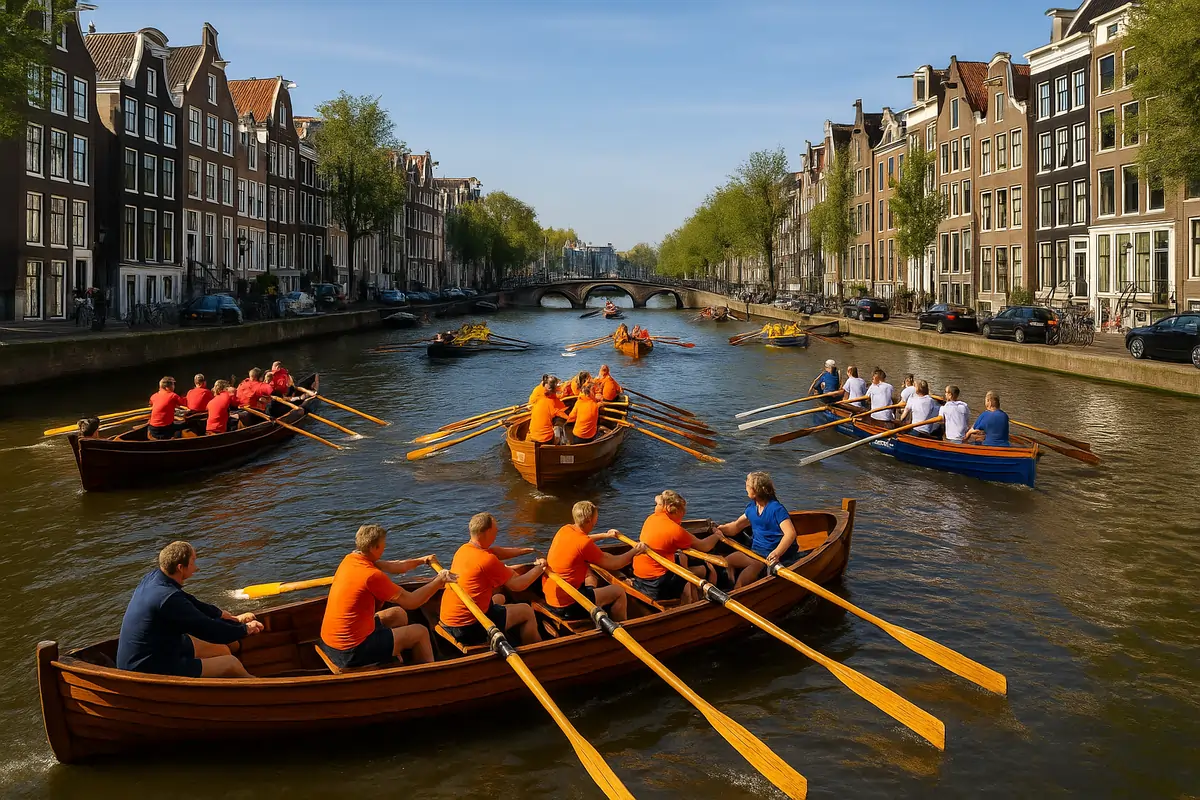
The Amsterdam Canal Race, widely known as the Grachtenrace, is one of the largest sloop rowing events in the Netherlands.
Each October, around 140 teams compete in a long-distance contest across Amsterdam’s canals.
The event blends sporting intensity with the city’s well-known waterways, attracting rowers, supporters and curious visitors every year.
Why was this race created?
The Grachtenrace began in the mid-1980s as a way to promote sloop rowing, encourage club participation and highlight Amsterdam’s canal culture.
In its early years, the event served mostly regional teams. Over time, interest grew as rowing clubs across the country adopted sloops as training and competition vessels.
By the 1990s and early 2000s, the race had turned into a national gathering for endurance rowing.
Today, the Grachtenrace remains a benchmark test for rowing clubs looking to prove strength, coordination and long-distance capability.
Where does the race start and finish now?
Since 2015, the start and finish have taken place in the waters around Olympic Stadium (Olympisch Stadion).
Organisers chose the stadium area because it accommodates trailers, team vehicles and support equipment.
With so many boats involved, this location provides the wide water access needed to launch and recover dozens of sloops efficiently.
Where were earlier starts and finishes held?
Before the move to Olympisch Stadion, the race was connected to Oosterdok near the Scheepvaartmuseum.
Limited logistical space eventually required a shift to the stadium waters.
Mentioning this history helps visitors understand why some older articles still reference Oosterdok.
How long is the course and what does it include?
The route covers approximately 25 kilometres. Although exact paths can vary each year, most editions include:
- Departure near Olympisch Stadion
- Part of the Amstel
- Entry into the canal belt
- Key passages through Herengracht, Keizersgracht and Prinsengracht
- A return to Olympisch Stadion for the finish
The route combines wide water sections with narrow corners and curved canal stretches, giving rowers a test of both endurance and control.

What makes the Grachtenrace demanding for crews?
Long-distance stamina
Rowing a heavy wooden sloop for nearly 25 kilometres requires continuous energy output.
Teams must maintain steady power for more than two hours.
Technical canal navigation
Many canals are narrow, with little room beside bridges.
Steering accuracy and crew timing are crucial.
Crowded stretches
With over a hundred boats in circulation, space is limited.
Crews often need to adapt quickly to traffic and slower competitors.
Bridge timing
Amsterdam’s low bridges require stroke adjustments.
A mistimed rhythm can cost valuable speed.
Sharp turns
Canal geometry forces tight manoeuvres, especially near Leliegracht, where many spectators gather to see how teams handle the bend.
Why are wooden sloops used instead of modern boats?
Wooden sloops were originally maritime support vessels.
Their shape and weight provide stability but demand a consistent team rhythm.
Rowing them is a point of pride for many Dutch clubs.
These boats also create close competition because design differences are subtle, making teamwork more important than equipment advantage.

Which teams take part in the Grachtenrace?
The field includes:
- Dutch coastal rowing clubs
- Amsterdam-based teams
- Recreational groups that train all year
- Mixed or all-female crews
- Company teams sponsored for the event
- Occasional international entrants
Many teams view the Grachtenrace as the highlight of the season, often training months in advance.
What is the atmosphere like on race day?
Visitors can expect:
- Crowds lining bridges and canal edges
- Supporters cheering from houseboats
- Music and friendly rivalry among clubs
- A festive atmosphere around Olympisch Stadion as crews prepare and recover
- Plenty of photo opportunities along the canal belt
The event captures a blend of sport and local character that appeals to both residents and tourists.
What are the top places to watch the race?
Herengracht at Leliegracht
Known for tight turns and high excitement.
Keizersgracht
Offers one of the clearest views of long sloop formations.
Prinsengracht bridges
Provide elevated vantage points for photographs.
Olympisch Stadion zone
Ideal for watching teams launch, compete and finish. Also home to the awards presentation.

What happens after the race?
Once all boats complete the course, officials tally results and host an award ceremony near the finish area.
Crowds gather as the top teams receive trophies and recognition for speed, technique and endurance.
How do teams prepare for the event?
Preparation often involves:
- Weekly endurance sessions
- Strength training for consistent rowing power
- Technical steering practice in narrow waterways
- Long-distance test rows
- Team coordination drills to ensure uniform stroke movement
Clubs begin training early in the season to prepare for the demanding nature of the race.
How can visitors reach the event?
The Olympisch Stadion area is well-connected. Visitors can arrive by:
- Metro or tram
- Bicycle
- On foot from nearby districts
- Ride-share services
Public transport is recommended because the stadium surroundings can become busy.
Is the race suitable for families?
Yes, the Grachtenrace is considered family-friendly.
Children often enjoy watching the colourful sloops and cheering teams as they pass bridges and canal edges.
Parents should take care near the water and choose secure viewing points.
What tips help spectators enjoy the race?
- Arrive early for the best viewpoints
- Bring binoculars for canal belt sections
- Wear comfortable shoes because moving between canals can take time
- Carry water or snacks, as crowds can slow movement
- Choose one or two fixed viewing areas rather than trying to follow the entire race
Frequently Asked Questions
Q. When does the race take place?
On the second Saturday in October.
Q. Can visitors watch the race for free?
Yes, all public viewing along the canals is free.
Q. Is it possible for tourists to join a team?
This depends on the team. Most clubs row with pre-organised crews.
Q. Where is the award ceremony?
Near the finish area by Olympic Stadium.
Q. How long does the average team take to complete the course?
Between 2.5 and 4 hours, depending on the crew and conditions.
Q. Are there rest areas for spectators?
Cafes and public seating can be found around the canal belt and the stadium vicinity.
Q. Do boats pass major landmarks?
Yes, depending on the route, teams can be seen near historical canal houses, bridges and well-known canal belt locations.
Where can visitors explore more canal experiences after the race?
If you are interested in discovering more of Amsterdam’s canal culture, once the Grachtenrace finishes.
You can explore some of the city’s most interesting waterside canal bars and hidden spots.
These relaxed venues offer great views, local character and a comfortable place to enjoy the rest of your day.